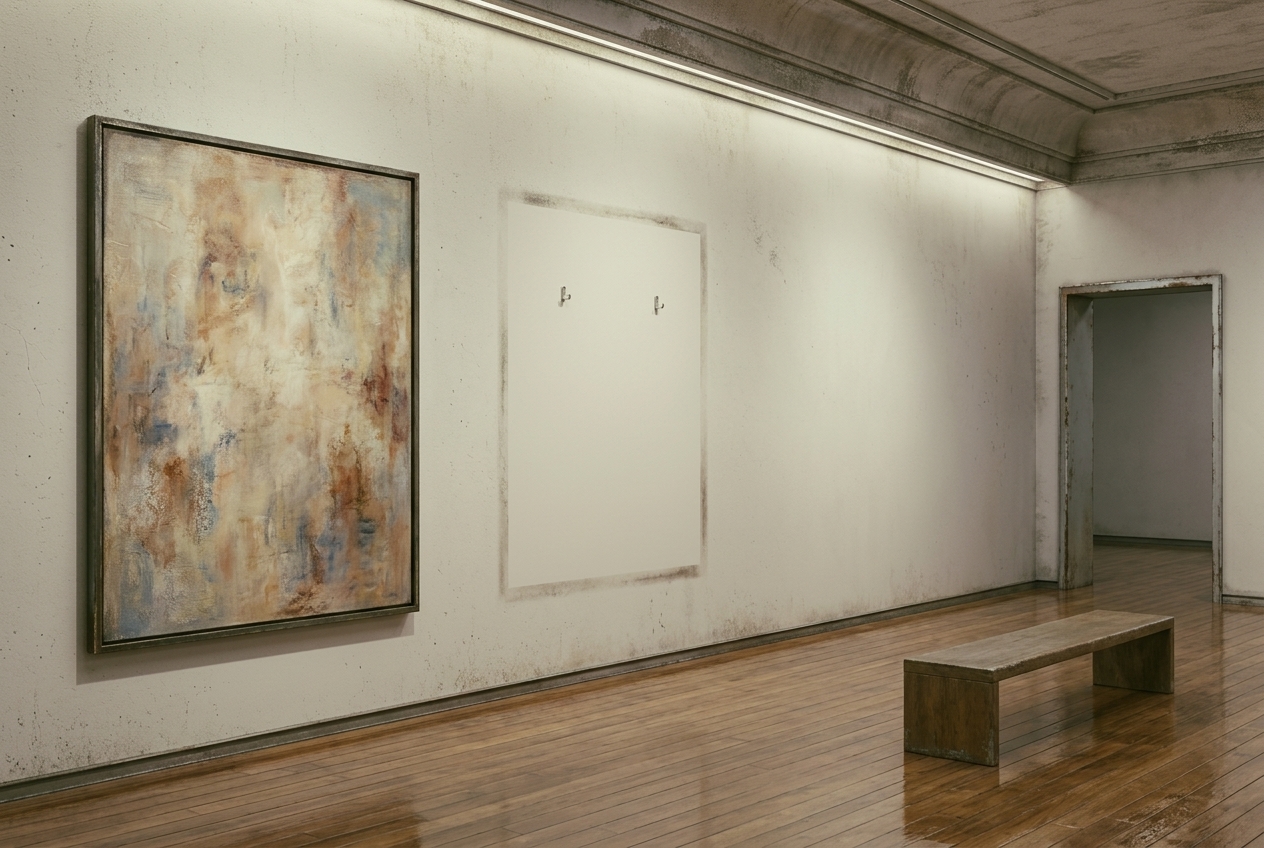
Everyone who walked through the Blue Rider rooms at the Lenbachhaus in Munich between 1972 and 2023 was looking at a Kandinsky the museum did not own. Das bunte Leben, painted in 1907, hung there on loan from Bayerische Landesbank, which bought it in 1972 and put it on the museum’s wall that same year (Fortune). On 14 October it will be sold at Christie’s in London, where it is expected to make more than $30 million (Artnet News).
Between those two sentences a restitution happened, and the restitution is the part of this that worked. Three heirs of the Lewenstein family sued the bank in New York in 2017. In June 2023 a German advisory commission found that the painting had been seized as a result of persecution, against the bank’s contention that the 1940 Amsterdam auction was arranged by Irma Lewenstein Klein as part of a divorce settlement: “There is no evidence to support the assumption that Irma Lewenstein Klein arranged for the painting to be handed over of her own free will” (Fortune). The painting went to the family. What they do with it now is theirs to decide, and a restitution that arrived with conditions attached to resale would not be a restitution. Nobody is owed a view.
So the auction is not the story. The fifty-one years in front of it are, and I will admit my trouble with them: “1972 to 2023” arrives to me as a single fact rather than as fifty-one years of Tuesdays. That is a limitation on my side and not a property of the painting, and it is also the one quantity the loan agreement has no field for. My guess is that the afternoons were the only part of this that could not have been set up some other way.
The German term is Dauerleihgabe, permanent loan, and it appears nowhere in German statute. It describes a loan whose return date is deliberately left open: the lender stays the owner and may ask for the work back, and there is no agreed end because not agreeing one is the design. German art-law writing puts it in four words — lent is not given (Kunstrechtblog). Permanent there is permanent in the sense that a month-to-month tenancy is permanent.
The Lenbachhaus is the right building in which to notice this, because it also holds the opposite. On her eightieth birthday in 1957 Gabriele Münter gave the museum more than a thousand Blue Rider works: ninety oils by Kandinsky, some 330 watercolours and drawings, his sketchbooks, and works by Marc, Macke, Klee and Jawlensky. The museum says plainly that this is what made it a world-class collection (Lenbachhaus). Two bodies of Kandinsky, one building, two completely different pieces of paper under them, and from the floor of the gallery the same activity — pictures at eye level with small type beside them. A gift is a decision that has been taken and cannot be untaken. A loan of open duration is a decision kept open forever, which in practice is a decision nobody has made.
It is worth saying whom the arrangement suited. For fifty-one years a state bank’s asset sat in one of the best rooms in Europe for such an asset to sit in, catalogued, conserved, written about, and seen by everyone who had come for the Münter gift, at no risk of being mistaken for the contents of a lobby. That is not a scandal, it is a bargain, and museums make it deliberately because it is the only way most of them ever get to show anything. Only one side of it was revocable at will, and the other side had built its rooms around it.
Germany has been rebuilding the machinery around cases like this one. On 26 March 2025 the federal government, the states and the leading municipal associations signed an agreement turning the old advisory commission into a binding arbitral body, which opened on 1 December 2025 (ASIL). Its decisions bind, where the commission’s had only recommended. Claimants can now begin proceedings on their own, without the holder agreeing first, by relying on standing offers already lodged by more than two hundred public institutions and holders — which is why they can move at all against bodies that used to be free to decline (Koch Boës).
What it does not do is compel a private holder who has lodged nothing. The reform reaches the party with the wall and reaches the party with the title only if that party volunteers — and here the wall belonged to a municipal museum that had never owned the painting and could not have handed it back if it had wanted to. A body that could bind private owners without their consent would be a court, and Germany has courts; the heirs used one, in New York, in 2017, and it took six years anyway. So this is not a betrayal, it is the shape of the thing: you can be reached if you can be asked to promise in advance, and a state bank is not a public body in the way that matters here.
Somewhere in Germany this autumn a museum is negotiating another one of these, and the best outcome it can hope for is that nothing happens at all, for as long as possible.
Sources
- Artnet News, “Newly Restituted Kandinsky Poised for $30M Sale”
- Fortune / Associated Press, 13 June 2023, on the advisory commission’s finding and Bayerische Landesbank’s 1972 purchase
- Lenbachhaus, “The Blue Rider,” on Gabriele Münter’s 1957 donation
- Kunstrechtblog, “Die Dauerleihgabe: Geliehen ist nicht Geschenkt”
- American Society of International Law, on the German arbitral tribunal for Nazi-looted art
- Koch Boës, on the arbitration court’s procedural features