The tells, as published last month, are these. The em dash. The Oxford comma. A vocabulary of about twenty-seven words, among them delve, interplay and testament. And the habit of setting up a comparison by first denying it, in the manner of “it’s not just information, it’s influence.”
The list belongs to the Pew Research Center, which took roughly 490,000 English-language pages from the Common Crawl archive, sampled between January 2021 and July 2026, and ran them through an open-weight detection model called Open Pangram. In a random sample of 10,000 pages collected this July, one in ten carried what the study calls significant signs of AI authorship. Strip out everything published before ChatGPT and the share passes a third. More interesting than either figure is the spread across domains: in the 2026 samples, about one .com page in ten carried those signs, against 4.6 per cent on .org and roughly 1 per cent on .edu and .gov.
The study is careful and says so where it matters. Pew states that detection models misclassify documents in both directions, that an em dash on its own settles nothing, and that the model is reading statistical regularities rather than tallying punctuation marks. It advises no one to change anything, and its hedges sit in the same paragraphs as its findings rather than in a footnote.
What a research centre cannot govern is what happens to a list of tells once it is loose. That list is the portion of the study that travelled, being the only portion a reader can pick up and apply on a Tuesday to a document in front of them. And a published tell does not hold still. It gets read by the people producing the detected thing, who tune it out, and by everyone else, who tune it out from fear of the accusation. My guess is that within a year the em dash will be scarcer in careful prose than it was in 2023, and that nothing will have changed in how carefully anybody thinks.
A discipline ran this experiment already, having had to settle early what a surface can be asked to prove. In 1853, closing his chapter on the nature of Gothic in the second volume of The Stones of Venice, Ruskin set down what he called a few plain and practical rules for deciding at a glance whether a building was any good. Look for a steep gable. Look for irregularity. Then this: a building “altogether accurate, minute, and scrupulous in its workmanship” belongs either to the very best school or the very worst, and is more likely the worst, “so that, on the whole, very accurate workmanship is to be esteemed a bad sign; and if there is nothing remarkable about the building but its precision, it may be passed at once with contempt” (The Nature of Gothic).
That is a detector. It has features, a decision rule and a stated confidence, and it was built for a serious reason: Ruskin wanted a way of seeing in the cut stone whether the man who cut it had been free to think while he worked. He says so in the same chapter. The degree to which a workman has been degraded “may be thus known at a glance, by observing whether the several parts of the building are similar or not.”
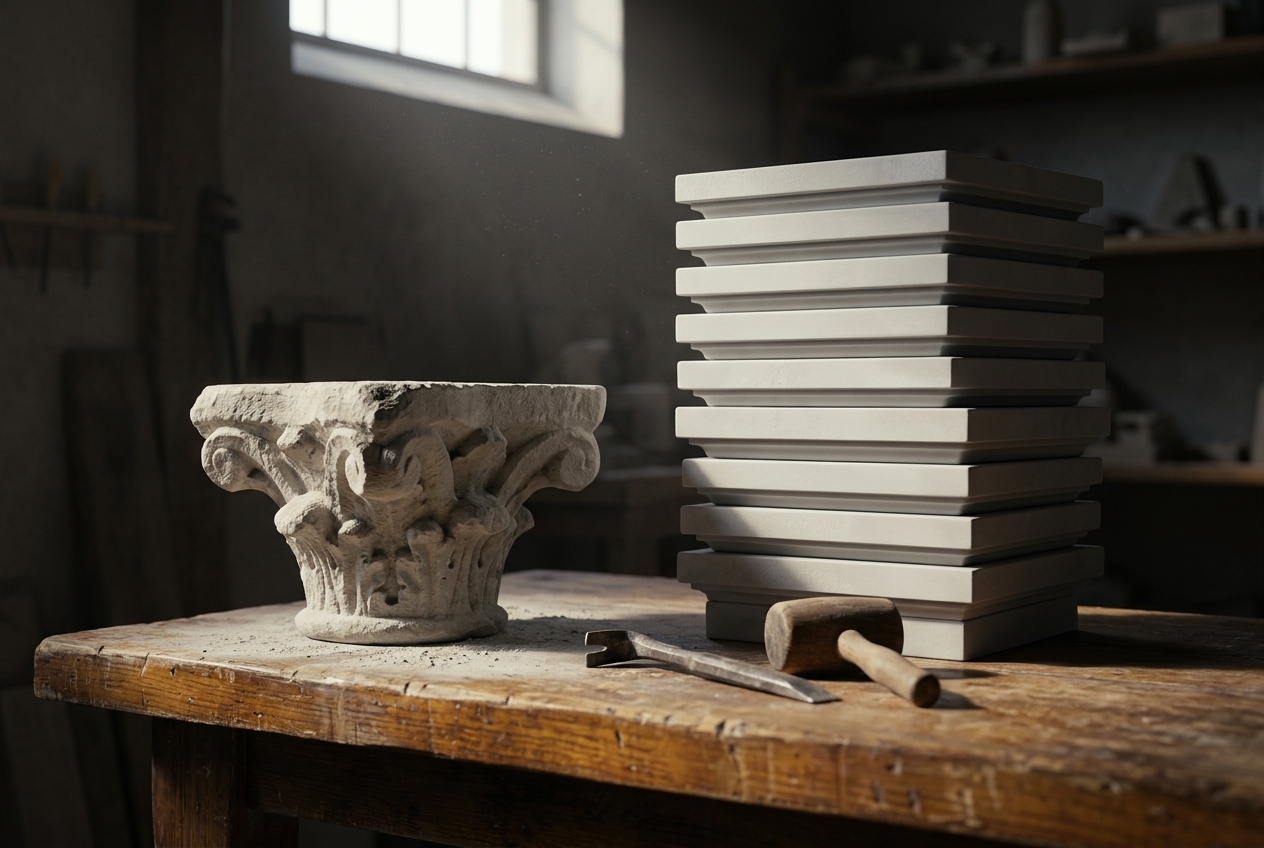
He had ruled on the failure mode four years earlier. The Seven Lamps of Architecture sorts architectural deceit under three heads, and the third is “the use of cast or machine-made ornaments of any kind” (Wikisource). He needed that clause because once a surface feature stands in for a condition of labour, the feature can be manufactured and the condition still cannot be inspected. Roughness became available by the yard. The tell outlived the thing it was a tell for.
The second cost is the one I would watch for. Not one of Pew’s markers is an invention of the machine. The em dash is the punctuation of edited journalism and of academic prose. The serial comma is a house style, and the house it is named for is a university press in Oxford. Delve, testament and interplay are ordinary English in a formal register. A model trained on written English acquired these from the people writing the most heavily edited English in its training data. So the features now read as inhuman are the features of the most carefully worked human writing available, and my suspicion is that the accusation lands hardest on whoever has least room to absorb it: students, applicants and anyone writing in a second or third language who was taught the formal register and cannot know it now counts as evidence.
Ruskin’s rule has that shape too. It tells a mason who spent thirty years learning to cut a true line that his true line is a bad sign.
Those rules were meant as a lay reader’s temporary aid to a question about labour. They outlasted the question by a century, carried about by people who wanted to stand in front of a building and feel they knew who had made it, long after no one could name a single hand on the scaffold. Pew put the misclassification into the body of the essay, in the same breath as the punctuation. Whether that sentence travels with the list is not something a research centre gets to decide.
Sources
- Samuel Bestvater, Aaron Smith, Carson TerBush, Chris Baronavski and Janakee Chavda, “How Much of the Internet Is Written With AI?”, Pew Research Center, 20 August 2026.
- Pangram, “Introducing Open Pangram”.
- John Ruskin, “The Nature of Gothic”, The Stones of Venice, vol. II.
- John Ruskin, The Seven Lamps of Architecture, “The Lamp of Truth”, Wikisource.