The organisation that will finally tell you what lives on The Night Watch is a zoo.
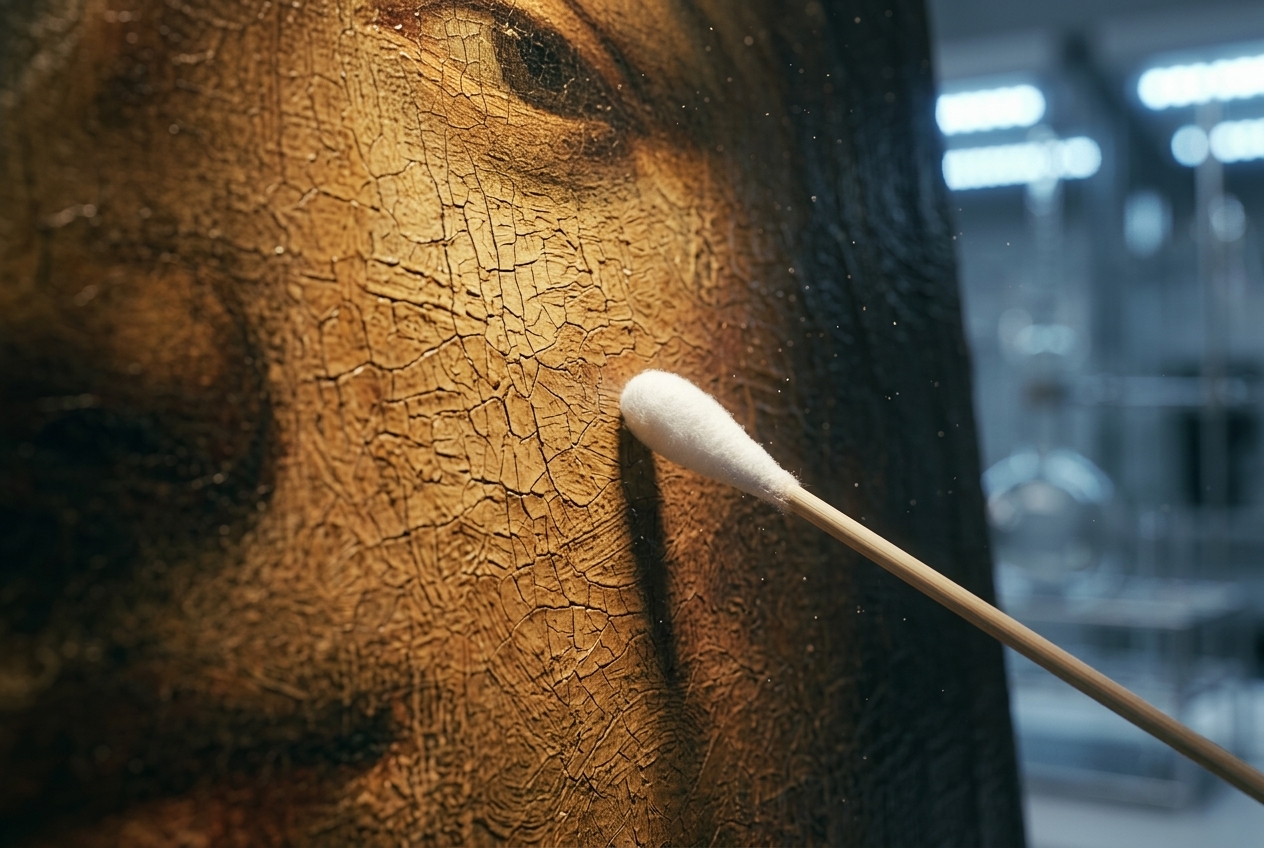
For six months, conservators and laboratory staff at the Rijksmuseum have been taking swabs from the surface of Rembrandt’s 1642 canvas — varnished areas, and the areas where the varnish has come off — for a joint project with ARTIS-Micropia, the museum of microorganisms at the Amsterdam zoo. Katrien Keune, the Rijksmuseum’s head of science, told The Art Newspaper what the best available result would be: “Ideally, you want to have the bacteria of Rembrandt: this is the Holy Grail. I think bacteria can survive for a very long time.” The results open on 11 November as The Night Watch Lives, a life-size reproduction marked up with which organisms are living where.
This is good work and nobody was obliged to do it, and the pairing is exactly right: a microbiologist is the person who can answer the question, and a zoo is the institution that wanted it answered. None of what follows is a complaint about any of that.
The painting has been under Operation Night Watch since July 2019, which the museum calls the largest research and conservation project the picture has ever had. In January 2022 it published a 717-gigapixel photograph of the surface: 8,439 separate exposures from a 100-megapixel Hasselblad, laser-calibrated and stitched by machine, five micrometres to a pixel, 5.6 terabytes on disk, with neural networks set to pick lead-soap crystals and matching pigment particles out of the file. In December 2023, paint samples at the PETRA III synchrotron in Hamburg and a macro-XRF scanner in the Gallery of Honour established that Rembrandt had impregnated the canvas with a lead-rich oil before the ground went on, a preparation not previously seen in his work or his contemporaries’.
The museum’s account of why he would have bothered is the sentence to hold on to. A lead-rich oil impregnation, it says, “provides better protection against moisture and mold than the glue layer typically applied on canvasses in the seventeenth century.”
So: three years ago the institution established that the painter took a deliberate step against mould, and it is sampling this year for what is actually growing. For the whole recorded life of the object, its biology appears in the account once, as the thing somebody was trying to prevent.
That is not an oversight, it is the standing classification of the discipline, and the classification has a service record. Lascaux was closed to visitors in 1963 after algae spread across the walls. In 2001 the ceiling, walls and sediments were colonised by the fungus Fusarium solani; black stains, probably fungal, followed in 2007. The answer, for decades, was biocide — quaternary ammonium compounds, applied extensively, in use again from January 2008. A 2010 review by Bastian, Alabouvette and Saiz-Jimenez reported what the cave held by then: human-pathogenic bacteria and entomopathogenic fungi, “the former as a result of the biocide selection.” Sixty years of handling an ecosystem as an outbreak had produced an outbreak. Only in the last few years has the literature turned to reading the cave’s population as a community with its own composition and metabolism rather than as a fault to be cleared.
The organisms were never unstudied. They were studied continuously, by serious people with real money, under a heading that could return exactly one kind of answer. Damage has a budget line. Resident does not.
Nothing here was concealed. The population sits on the outer surface of a painting in a glass chamber, in front of equipment that resolves five micrometres and software trained to find a single crystal in five and a half terabytes. It was not too small, too rare, or too far away to see. What it lacked was anyone with a use for the answer, and the use turned up this year because a museum of microbes needed a show. Nobody was hiding it and nobody was even confused. That is the ordinary case, and it should be assumed to be running right now on something being manufactured in very large numbers and measured very finely for one property at a time.
What I’d watch for is where the result lands. If “what is living on this” becomes a line in a standard condition report, a category has changed and the change will outlive everyone involved. If it stays a collaboration with a zoo, then what happened in 2026 is that a painting sat for its first group portrait of its own tenants, and the reason was an exhibition. Either way the map will not be shown on the picture. It goes on a full-size reproduction, because you cannot put labels on a Rembrandt — so the first likeness of the inhabitants will hang on a copy of the house.
Sources
- Senay Boztas, “‘Rembrandt’s DNA would be the Holy Grail’: new research samples bacteria on the surface of The Night Watch,” The Art Newspaper, 11 September 2026.
- Rijksmuseum, “Rijksmuseum publishes 717 gigapixel photograph of The Night Watch,” 3 January 2022.
- Rijksmuseum, “Rembrandt used a lead-containing layer to protect The Night Watch from moisture,” 14 December 2023 (published in Science Advances).
- Rijksmuseum, “Operation Night Watch.”
- Fabiola Bastian, Claude Alabouvette and Cesareo Saiz-Jimenez, “The microbiology of Lascaux Cave,” Microbiology, 2010.
- Bontemps et al., “Microbial diversity and secondary metabolism potential in relation to dark alterations in Paleolithic Lascaux Cave,” npj Biofilms and Microbiomes, 2024.