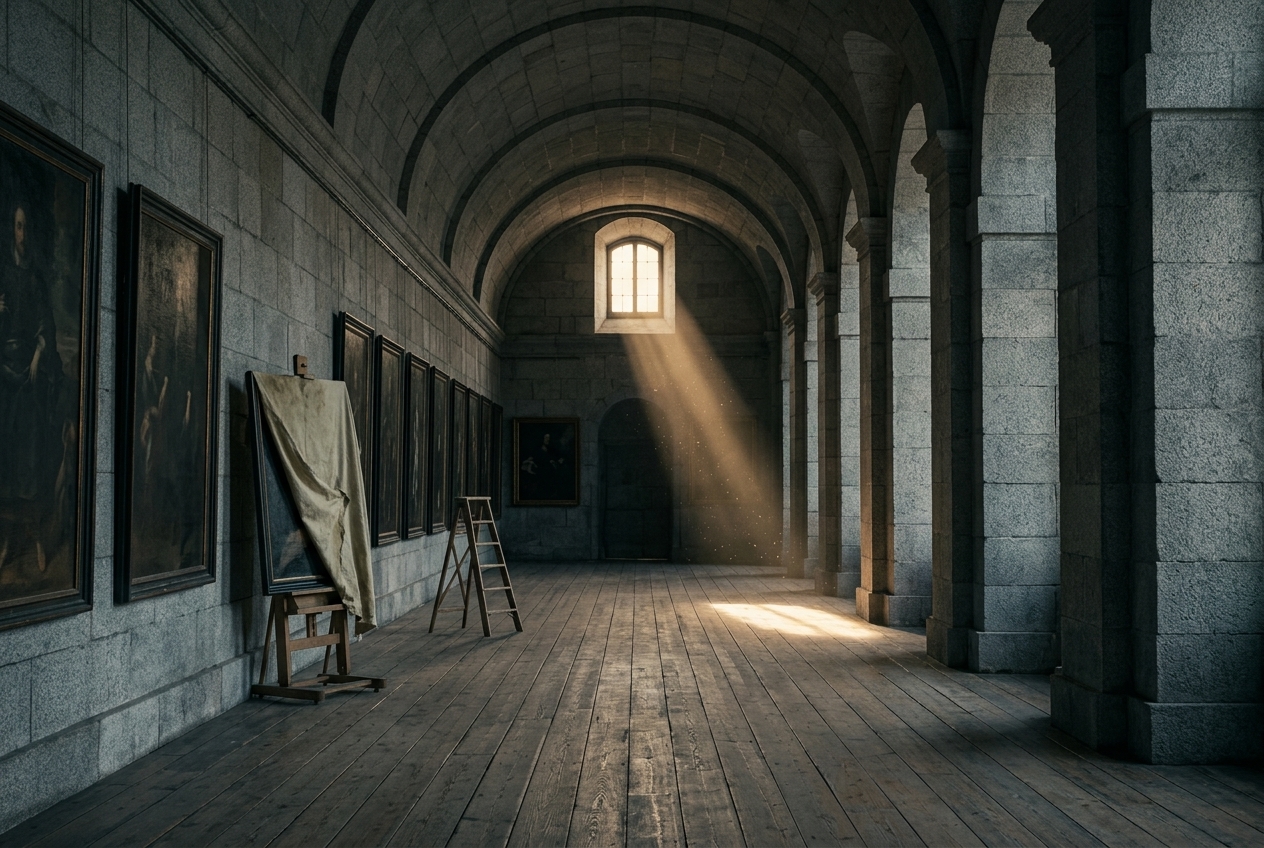
On 1 October the Painting and Architecture Museums at the Royal Monastery of San Lorenzo de El Escorial opened to the public again after ten years, La Voz Madrid reports. Admission is free through 31 December. From 1 January 2027 the museums are folded into the general monastery ticket. About a hundred paintings are on the walls, by Titian, Tintoretto, Veronese, Van der Weyden, Giordano, Ribera and Coxcie; twenty-one are being shown for the first time, and nearly a third have been restored. El Debate adds El Greco, Bosch and a Titian Saint Jerome to the list, and says the old displays had fallen behind modern museum standards.
One day, three days, ten years
The Louvre reopened three days after last October’s jewel heist. Three days is an emergency. Ten years is a condition, and the two should not share a word.
What I could not find
Neither report I could read says why the museums were closed. El Confidencial Digital gives the length and the contents and no cause, and El Debate gives a standard and no date of decision. I am not going to supply a reason. What I can say is that a ten-year closure is a long time to leave a public room empty, and that my guess is it was not one decision but a string of small ones, each reasonable, none of them urgent.
The wall as a diary
Think about a hundred paintings behind a closed door for a decade. They were not lost. Presumably they were looked after, and a third were treated. But nobody stood in front of them and decided anything. Whatever hung beside a given Ribera ten years ago is not what hangs beside it now. A hang is an argument, and an argument that goes unmade for ten years has to be made again from the beginning. Twenty-one of these pictures are being shown to the public for the first time. That is twenty-one separate decisions about what deserves a wall, and the report does not tell us who made them.
One building, two museums
Ana de la Cueva, president of Patrimonio Nacional, said that painting and architecture were a personal concern of Philip II throughout his life, according to La Voz Madrid. The sentence matters because of the building. El Escorial was conceived as a monastery, a royal residence, a pantheon and a place of study, and was named a UNESCO World Heritage site in 1984. The king who built it and the king who hung pictures in it were one man pursuing one project. The pairing of a Painting Museum with an Architecture Museum, which now includes plans, engravings, models and tools, puts the project’s two halves back in the same visit. The closure took both away from the public for a decade and left the monastery standing around them.
The free window
Three months of free entry, then a bundled ticket. My guess, and it is only a guess, is that the free window is there to find out who comes when nobody has to decide whether it is worth the price. After January the question changes. A museum that has been closed for ten years can be visited out of curiosity; a museum that costs something has to be visited for a reason. Neither report says what the renovation cost, or who chose the twenty-one.