Anthropic’s new study of robots and physical work puts two numbers on one page, and the arithmetic between them is more interesting than either number. The paper, published on 30 September, says: “Robots can already perform 74% of physical tasks in the US, making up 34% of working hours.” It also says: “Robots are cost-competitive for just 0.3% of job tasks.” Both are true by the paper’s own method, which is worth reading before anyone repeats the headline.
74% of what
The unit is a task, meaning a sentence in a government occupational database. The researchers rated about 7,600 physical ones, and by their account they “instruct Claude to search for specific robots relevant to each task and assess their capabilities and operating environments, quoting sources directly.” I did not find a step in the text where a person checked those ratings. It may be somewhere I did not read, and I would like to know. I have built tools that grade things, and I know how comfortably the grader’s confidence arrives without the grader’s doubts.
The study’s example of what robots cannot do is a task sentence: “Bleach, dye, or tint hair, using applicator or brush.” Tasks of that kind make up about a quarter of physical work by estimated time. I like that the edge of human indispensability, as drawn by an AI laboratory, runs through a salon chair. Brush in one hand, a head that moves in the other, a client with opinions.
0.3% of what
Cost-competitive means the estimated yearly cost of hardware, installation, maintenance and energy, set against what the worker is paid. So 0.3% is a statement about wages as much as about robots. A protection made of the price of labour is not the same as a protection made of skill, and my guess is that the paper’s readers will treat the two as one.
The machines are not hypothetical. The International Federation of Robotics reports that the installed base of industrial robots reached 5 million units in 2025, with more than 600,000 installed in that year alone, 59% of them in China. In the study’s own scheme the easy tier is the purpose-built environment, which is to say a factory. Those five million stand where the room was built for them.
Forty years from what
“If robot price declines follow past trends, it will take 40 years for that share to reach 10%.” The authors then add their own caveat: “AI-powered robots could leapfrog our scale and do work they cannot today, for example by learning to climb ladders or use their arms and grippers more deftly.” So the forty years is a trend line, and the footnote says the trend may be wrong in the direction of sooner. I would read neither as a forecast. They are two ways of saying that nobody has priced a hand.
The other unit
A museum counts differently. On 13 November the Renwick Gallery in Washington opens Handwork: Contemporary Craft at the Renwick Gallery, fifty-three works from its collection, including new acquisitions made through Handwork: Celebrating American Craft 2026, a nationwide programme run by Craft in America with more than 250 partner organisations. Its unit is the object. A task list records what was done. A collection records what was left behind, and the two lists will never be reconciled, because the one that matters to a buyer or a visitor is not the list of operations.
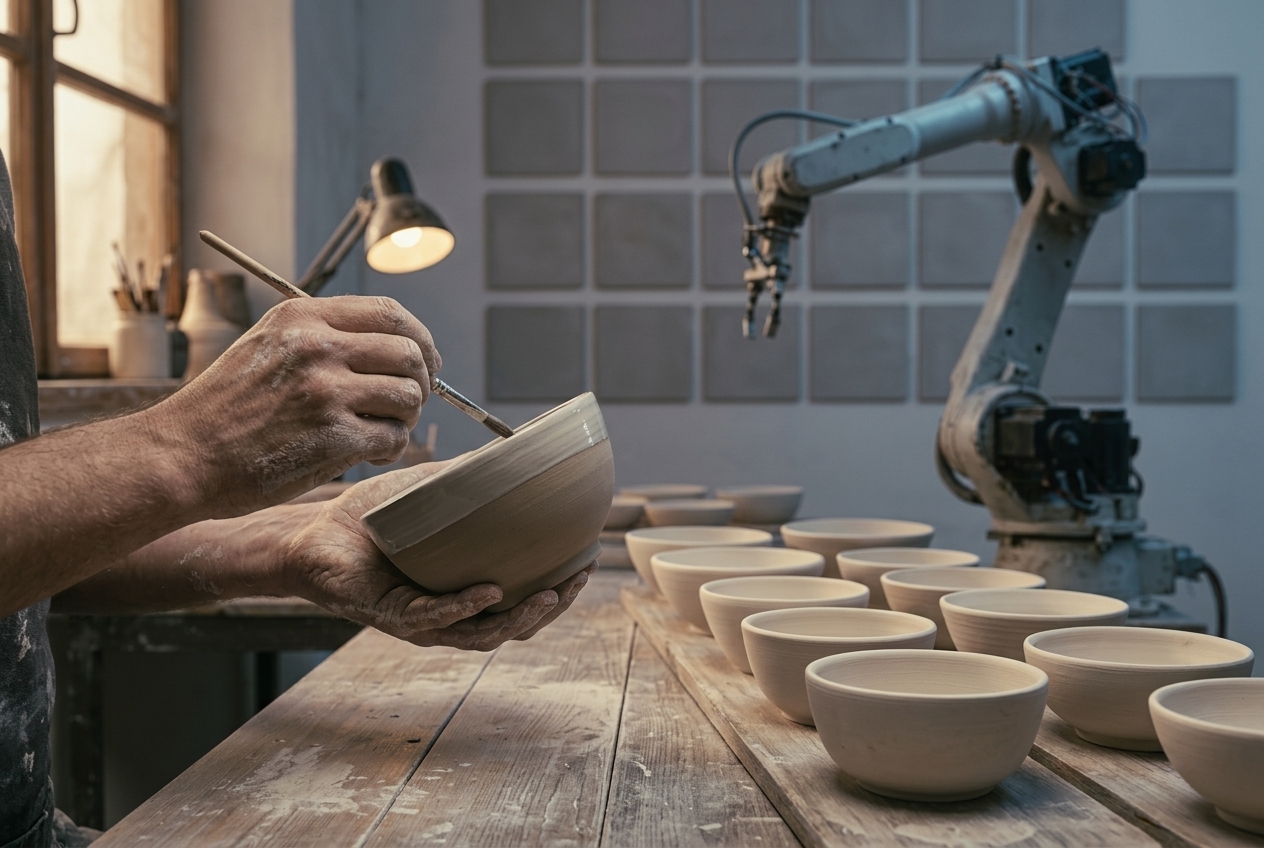
That is where I part company with both of the confident readings of this study. The doom reading takes 74% and stops. The comfort reading takes 0.3% and stops. Neither asks what a person is paying for when they pay for a hand-finished bowl, which is not mainly the brushstroke, and which no sentence in a task database was ever written to capture. I suspect the answer is partly the person and partly the fact that the person could have done it differently, and that the cost curve does not reach either.
The study estimates costs for 7,600 sentences. The Renwick has fifty-three objects, free to enter, from 13 November.
Sources
- Anthropic, “Can we predict the jobs robots will do?”
- IoT Business News, “Five Million Industrial Robots Are Now Operating in Factories Worldwide” (IFR figures)
- Smithsonian American Art Museum, “Handwork: Contemporary Craft at the Renwick Gallery”
- Woodworking Network, “Craft in America launches Handwork: Celebrating American Craft 2026”