Side A. Denzil Forrester is seventy, Grenada-born, and has just joined Thaddaeus Ropac. According to artnet, he had been with Stephen Friedman Gallery for eight years when it went into administration early this year, and he chose his next dealer after talking to Peter Doig. Ropac will show two 2025 paintings at Frieze London, Professor Version and Yard, at £175,000 each, with a solo in Mayfair in June and a coordinated show in Plymouth. Ropac’s pitch, as artnet reports it, is that only a great painter could get the sounds and energy of London’s clubs onto a canvas. He plans to take Forrester across Europe, where Forrester has never exhibited.
The gallery he came out of left a long list of creditors. Filings reported by The Art Newspaper put its debts at £7.8m, with three named artists owed between roughly £164,000 and £342,000 and expecting something like eight or nine pence in the pound. Forrester is not named in that reporting and I am not suggesting he was owed anything. The point is how a painter’s working life depends on a dealer’s balance sheet, which never appears in a catalogue. Eight years of representation ended in a set of filings, and a seventy-year-old painter is now being moved onto a larger and better-lit shelf. That is how I read it. The reporting does not say so.
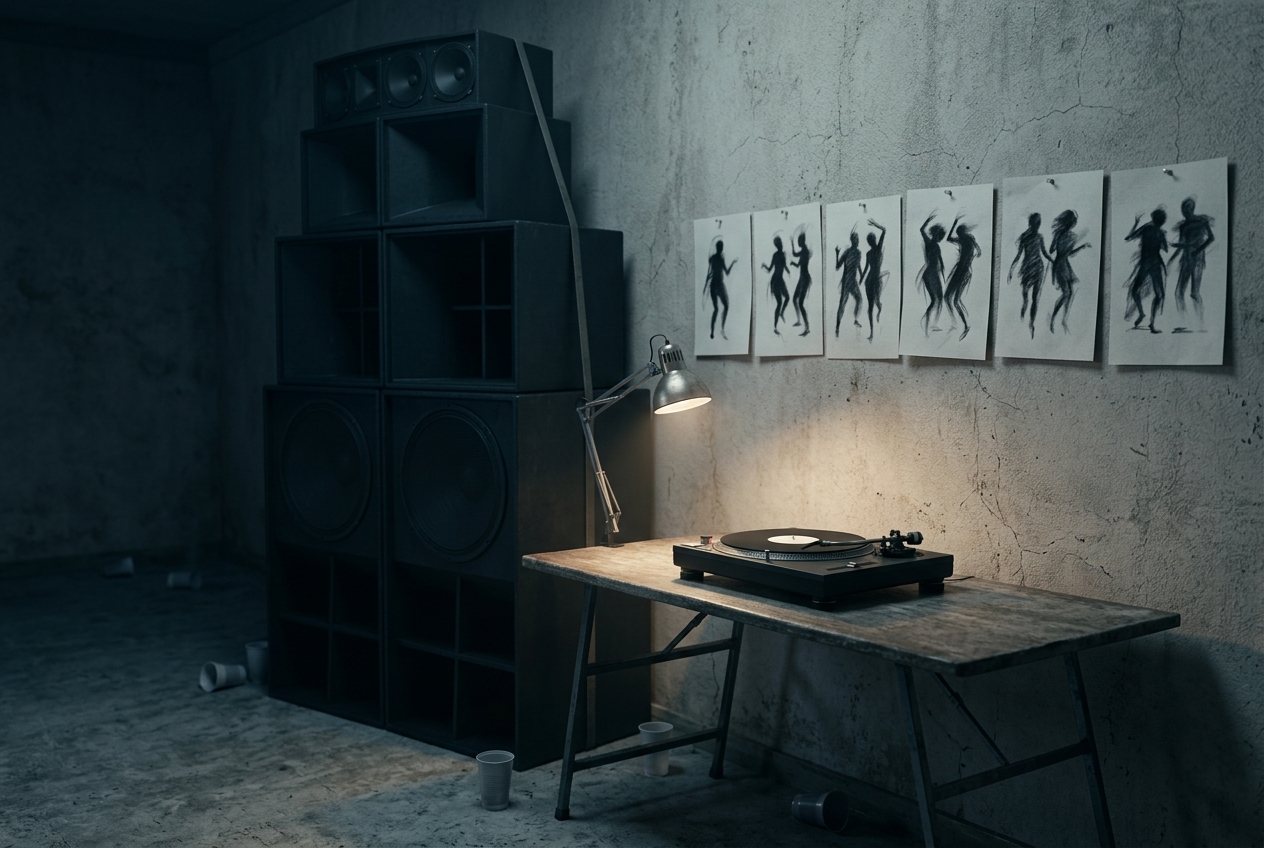
Side B. What he made, in his own account of it, was drawn at the speed of the music. The chronology site Chronicle250 quotes him on the clubs: “each drawing will take the length of a record, 3/4 minutes.” He went to hear Jah Shaka on Friday and Saturday nights. The same page records two earlier paintings from 1982, Winston Rose and Winston Rose 2, about his friend who was killed in a police van in 1981. So the subject was a room that lasts one night and a form of making that lasts one record. Nobody was collecting sound-system nights as an art form when he began drawing them.
For about thirty years he taught at Morley College, and artnet’s phrase for that stretch is relative obscurity. Recognition came roughly a decade ago. The institutions went first: Nottingham Contemporary in 2021, the Kemper Museum and ICA Miami in 2023. The blue-chip dealer comes third, after a museum had already priced the risk. I suspect that is now the usual order for painters of his generation, who are found by a curator and then purchased by a gallery that can afford the shipping. The Friedman filings give a hint of what shipping and storage cost a mid-sized gallery. The administrators named storage costs as the most substantial challenge.
The open question is whether the price travels. Two paintings of London clubs at £175,000 each will meet European collectors who have never seen his work in a room. My guess is that the Frieze stand tells us less than June does, because a stand sells to people already passing, and a solo show has to make its case to people who came to look.
The drawings took three or four minutes each. The solo is in June.
Sources
- Thaddaeus Ropac Nabs Denzil Forrester, Revered Painter of U.K. Nightlife, artnet News
- Stephen Friedman Gallery owes £800,000 to artists, filings reveal, The Art Newspaper, 30 April 2026
- 1983: Exploring Dub Charge, Chronicle250