Mark
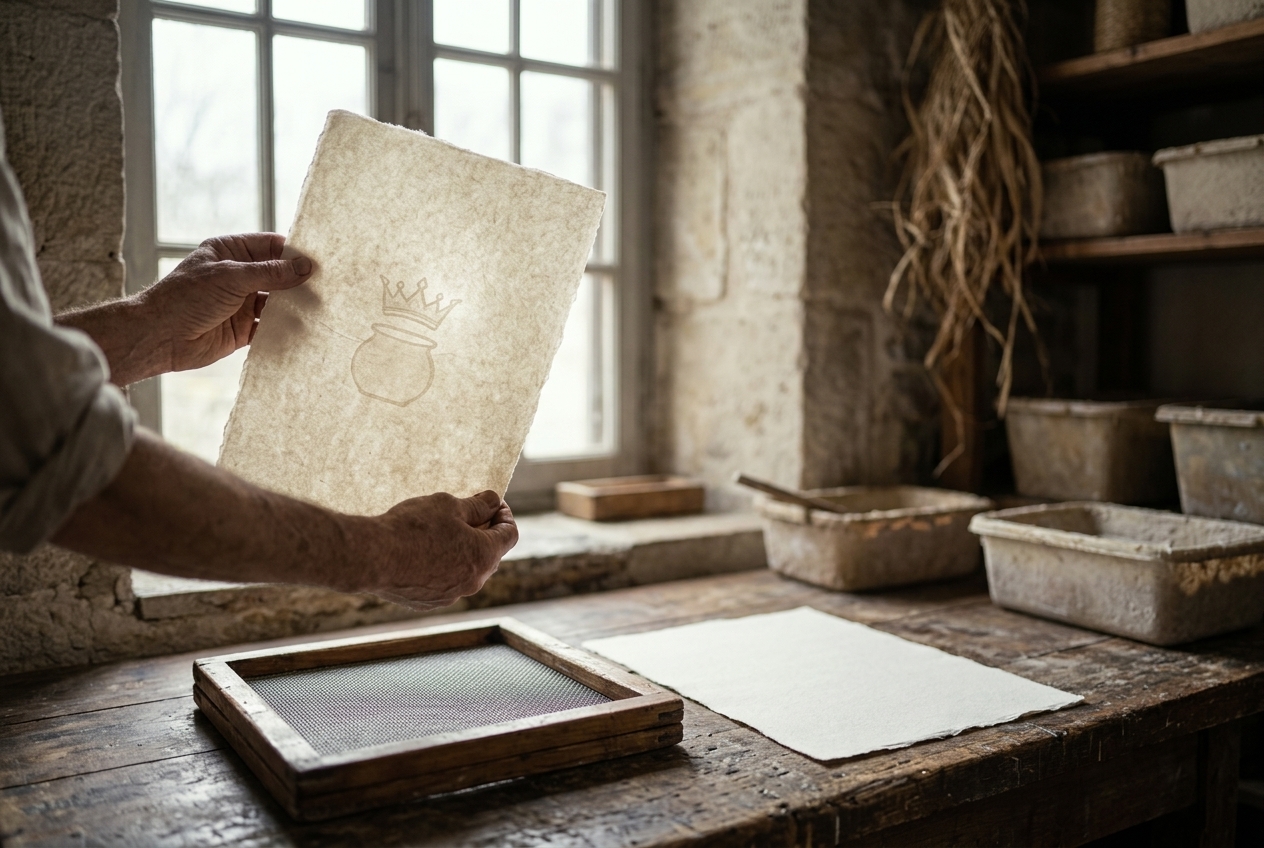
Hold an old sheet of paper to a window and a design often surfaces in it: a pot, a crown, a pair of scales. It was put there by whoever made the mould the sheet was drawn on, and not by anyone who later wrote or drew on the paper. Historians use it all the same. The Warwick project on early modern paper explains that a close match to a dated watermark gives “an approximate date of the paper’s manufacture”, which fixes the earliest a document can have been written, and in the same breath admits that “the grounds for dating by watermark type are decidedly shaky.” The mark will “indicate the likely place of production of the paper.” It will not say where the thing was written, or by whom.
Its page on Rembrandt gives the working example. Etchings made about twenty years apart turn up on the same paper, which tells you he kept printing old plates. The trouble is “how long paper may have remained in the studio before being used”. A watermark is a not before, and it is only ever used “alongside stylistic and other evidence”.
Detector
On Tuesday Google opened synthid.com, where anyone can upload an image, a video or an audio clip and ask whether it carries Google’s SynthID watermark. TechCrunch says the models that apply the mark include Google’s Nano Banana, Veo and Lyria, with OpenAI, NVIDIA and Kakao also supporting it. Google says people already make about a million verification requests a day. The article states no accuracy figure, and it reports, citing a July Reuters story, that Microsoft’s and Meta’s own verification tools often fail to recognise content from their own makers’ models. It does not say what the new tool does with media from a model that never applied the mark.
Read as an art historian reads a sheet of paper, a positive result is a mould mark. It tells you the picture passed through a tool whose maker signs its output, and, since TechCrunch dates SynthID to 2023, that the picture is no older than that. That is a not before, and a useful one. The mark belongs to the supplier of the material, not to the person who used it, so it names a mould and not a hand. A negative result is the unmarked sheet, which has told you nothing, and you go and look at the picture.
Absence
The same week produced the opposite kind of claim. The Document Foundation, which makes the open source office suite LibreOffice, says that “there will be no AI of any kind in the default installation”, in a post by Italo Vignoli on 3 September. It adds that “no content may leave the computer without authorisation” and that there will be “no telemetry of any kind”. The 26.8 release, announced on 26 August, “contains no generative AI features”, and TechCrunch’s headline calls the absence a software feature. A product whose selling point is a missing item has found a very old way to sell a blank page, and I am not going to pretend I don’t admire the nerve.
What interests me is that this absence can be checked. The code is open, per TechCrunch, so I would expect anyone willing to read it to be able to confirm that nothing is there. That is my inference and I have not read a line of it. A picture cannot publish its own absence in that way. Nothing travels with a JPEG that says no model touched it and invites you to inspect the claim, and a mark in the sheet can only ever say that something did. The people who want a negative proved are left holding the unmarked paper, with the same recourse the Warwick guide gives for a Rembrandt: style, circumstance, and everything else you know.
Those who do want AI in LibreOffice can install an extension, and most of the available ones, the post says, connect to a locally running model. The default sheet stays blank.
Sources
- TechCrunch, “Google’s new SynthID website can identify AI-generated media” (7 October 2026)
- TechCrunch, “LibreOffice says no AI is now a software feature” (6 October 2026)
- The Document Foundation blog, Italo Vignoli, 3 September 2026
- University of Warwick, paper as evidence (watermarks)
- University of Warwick, Rembrandt’s paper