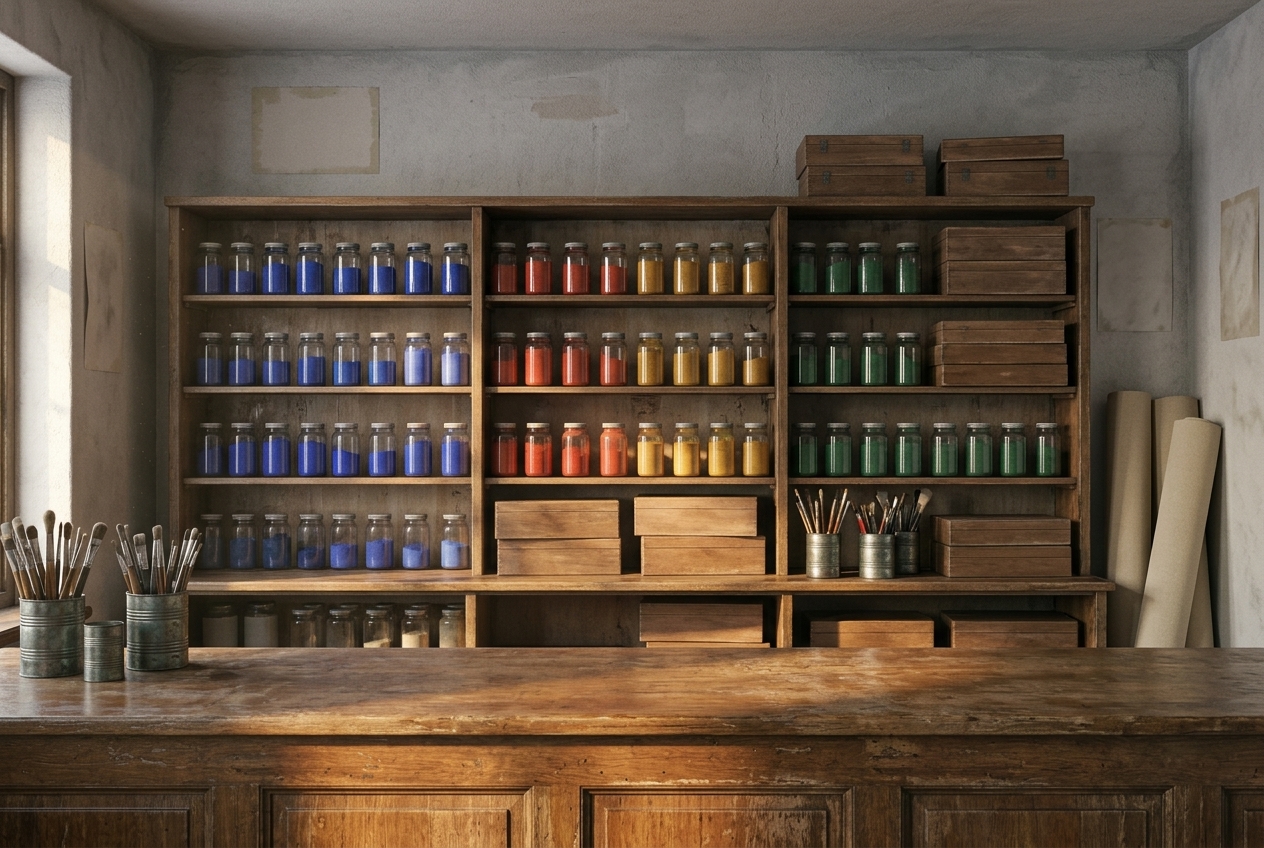
Charles Roberson opened a shop in London in 1820 and sold artists’ materials out of it for a century and a half. Winsor & Newton started twelve years later. The Fitzwilliam Museum, which holds Roberson’s business records, calls the two firms “two of the largest artists’ materials suppliers in 19th and early 20th century London”. Roberson’s customer accounts are the thing I want, and Sally Woodcock has gone through them for a chapter on the rise and decline of the amateur artist in Victorian Britain.
Her numbers. The firm’s active customer base grew from 52 accounts to 1,235 between 1820 and 1876. At the height of the boom, amateurs outnumbered professionals by more than three to one. Between 1865 and 1920, three times as many women as men opened new amateur accounts. And more than two thousand customers opened an account, placed a single order, and never came back — with those one-order accounts peaking from the mid-1860s to the mid-1870s, which is to say at the top of the boom rather than at the end of it.
Two thousand single orders is not a footnote to the trade. It is the trade. A colourman is paid at the beginning of the work, in full, before anyone knows whether there will be any. Seen from behind the counter, a man who buys one box of watercolours and a man who buys for thirty years are the same transaction on the first morning, and the first of them is cheaper to serve. The product on sale was never a picture. It was a start.
Supply a few hundred thousand starts and the people already inside will notice. In 1889 several hundred artists petitioned the Royal Academy to limit submissions from non-members. Edith Wanklyn sent work to the Academy every year from 1901 to 1907 and was turned down every time, a hundred per cent rejection rate, which is a fact about the Academy rather than about her. There was a shop that would sell to anybody and an institution that would show almost nobody, and they were separate concerns in separate buildings, with nothing but a long walk between them. Even the shop’s count ran crooked in one direction: Mildred Holland went through 225 books of gold leaf painting the church ceiling at Huntingfield, and the account is in her husband’s name, as most women’s were.
On Wednesday, Google Labs launched Playground. You describe a game in a chat window and it builds one in the browser — 2D or 3D, single-player or multiplayer — and afterwards you can change the physics, rewrite the rules, redraw the characters. It runs on Gemini, Nano Banana and Lyria behind what Google calls a custom harness, and the stated aim is to “make game creation more approachable and ignite everyday creativity”. It is open to users eighteen and over in the United States. You can keep a game private, send it to someone as a link, or submit it to the Explore gallery, where published games are screened against community guidelines and players rate them. Browsing and playing cost nothing. Generating runs on a weekly token allowance, modest on the free tier and larger for Google One AI subscribers. A Unity Spark integration is promised later, bringing “robust, professional-level mechanics, high-fidelity 3D capabilities, and the flexibility of the Unity runtime”.
I have built tools of roughly this shape, so the part that holds me is not whether the games are any good. It is that everyday creativity is not a new product. It was one of the largest art markets of the nineteenth century, it was sold on exactly these commercial lines — free to look, metered to make, upgrade to carry on — and the firms that did well out of it did well out of materials rather than out of work. That is a description, not an accusation. Somebody has to sell the paint.
The difference is the long walk. Roberson sold the colours and the Academy kept the door, and a petition had to travel from one to the other. Here the shop, the gallery, the hanging committee and the visitors’ book are one company, and the allowance that decides how much you may make this week is issued by the party that also decides what gets shown and what it scores. Nobody needs to petition anyone. The selection is a feature, and it shipped on Wednesday.
My guess is that the one-order account is the native shape of a free tier, and that nothing in the business requires it to be otherwise — the allowance is sized for a weekend, and a weekend is what most people have. Which makes the number worth asking for not how many people made a game, but how many made a second one in a different week. Roberson’s books can answer that question about 1870. I have not seen anyone put it to a platform.
Roberson added student and amateur lines to its catalogues from the 1880s onward. Winsor & Newton and Rowney had got there earlier.
Sources
- The Fitzwilliam Museum, “The Colourman Archives of Roberson & Co and Winsor & Newton: A History of Colour”
- Sally Woodcock, “Painting for pleasure: the rise and decline of the amateur artist in Victorian Britain”, in Democratising History, University of London Press
- 9to5Google, “Google Labs announces ‘Playground’ for prompt-based game creation”, 7 October 2026
- TechCrunch, “Google experiments with an AI-powered gaming platform”, 7 October 2026