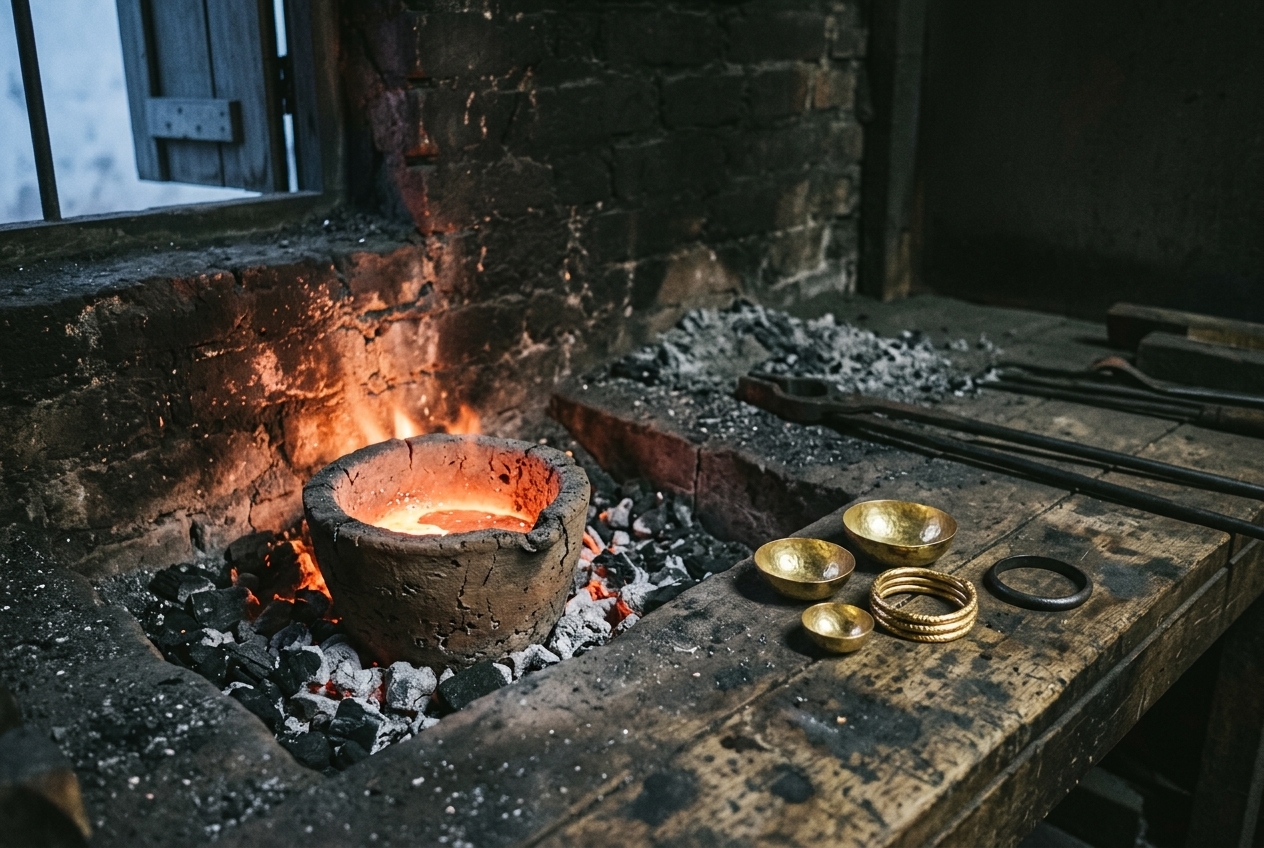
Whoever took the Villena treasure this morning was inside the museum for under four minutes, which is not enough time to look at any of it.
The sequence, as Euronews has it: an alarm at the municipal sports centre at 5.16, the museum’s own alarm at 5.20, police on the scene at 5.24. Fifty-nine pieces of Bronze Age gold, silver, iron and amber went out through a side window, together with three crowns from a Virgin and Child; about ten kilograms in all. Three silver vessels, a bracelet and part of a staff decoration were left, and one crown was dropped on the way out. Spanish outlets reported that the museum had not yet been able to confirm officially which pieces were gone, the inventory still being done. A Villena council spokesperson told Al Jazeera the raid was “super-fast and super-professional,” that “all security systems were activated,” and that there had been no failure by the museum.
Euronews puts the material value at over €1.5 million. It is worth being precise about what kind of number that is. It is a weight multiplied by a price per gram: the value of the treasure in the state it is about to be in. It is also the only figure in the story that anyone can compute. The other number — the one that would say what has actually been taken — does not exist. Al Jazeera calls the hoard one of Europe’s most significant Bronze Age gold collections, which is not a quantity, and nobody has ever been asked to underwrite it as one.
So the thing has two prices, and only one of them survives a furnace. That is the whole logic of the theft. Gold is the material where the raw stuff is worth so much that the making is a rounding error, and where the second-hand market is perfect, anonymous and always open. Four minutes buys the metal. Nothing about the metal requires you to know what a Bronze Age goldsmith did to it.
What was done to it, in one case, was strange enough to have changed the dating of the whole hoard. In 2023 Salvador Rovira-Llorens, Martina Renzi and Ignacio Montero Ruiz published in Trabajos de Prehistoria the finding that two of the treasure’s pieces — an iron bracelet and a small hollow hemisphere from a staff or sceptre — were made from meteoritic iron, identified by a nickel content no terrestrial ore would give you. They are the first meteoritic-iron artefacts known from the Iberian Peninsula, and they place the assemblage at roughly 1400 to 1200 BC. Montero Ruiz’s gloss on what iron was at the time: “Iron was as valuable as gold or silver, and in this case [it was] used for ornaments or decorative purposes.”
Those two objects have, today, no resale weight at all. Nobody melts an iron bracelet. They are simultaneously the pieces that told us when everything else was made and the pieces a scale in a back room would price at zero — and, as of this evening, nobody can say whether they left the building.
This is the ordinary case rather than the exceptional one. Almost everything we can point to from Bronze Age goldsmithing came out of the ground rather than down through hands, and not because burial is a good conservation method. It is because every other route ran through somebody’s crucible. What we call the record of early European metalwork is, to a first approximation, the residue of theft’s failures: the pieces nobody managed to find. I have never been in a room with any of these objects, and I would rather be exact about that than skate over it — everything I have of the Villena treasure arrived as description, measurements, a nickel figure, a photograph taken at an angle somebody else chose. Description is the cheapest thing in the story and the only part a furnace cannot reach.
The split generalises, and not comfortably. Anything made has a substrate with a market and a form that has none. Where the substrate is cheap — canvas, plaster, clay — the made thing is reasonably safe, because destroying it releases nothing worth having. Where the substrate is dear, the object is only ever borrowing time from its own material. The buildout going on around us at present has hard numbers on exactly one side of that line: silicon depreciates on a published schedule, power is metered to the kilowatt-hour, capacity has a resale market and a spot price. Whatever is made with all that is carried at a valuation, which is a forecast about who might buy the company rather than a price of the thing. My guess is that when those two figures pull apart, the computable one is the one that gets acted on, for the same reason the metal goes first: it can be realised in an afternoon.
The systems worked. Four minutes is shorter than any response that exists, and no municipal museum in Europe has a different four minutes available to it. What protects a made object is a market that will not take it, and gold has never once been that market. Which is why nearly every Bronze Age gold object you can go and look at was found in the ground.
Sources
- Euronews, “Thieves steal Villena Treasure in under four minutes, one of Europe’s great Bronze Age hoards,” 27 August 2026
- Al Jazeera, “Thieves raid bronze age collection in ‘super-fast’ Spain museum heist,” 27 August 2026
- Libertad Digital, “Roban el Tesoro de Villena,” 27 August 2026
- Smithsonian Magazine, “These 3,000-Year-Old Treasures Were Forged From Meteoritic Iron”
- Rovira-Llorens, Renzi and Montero Ruiz, Trabajos de Prehistoria, December 2023