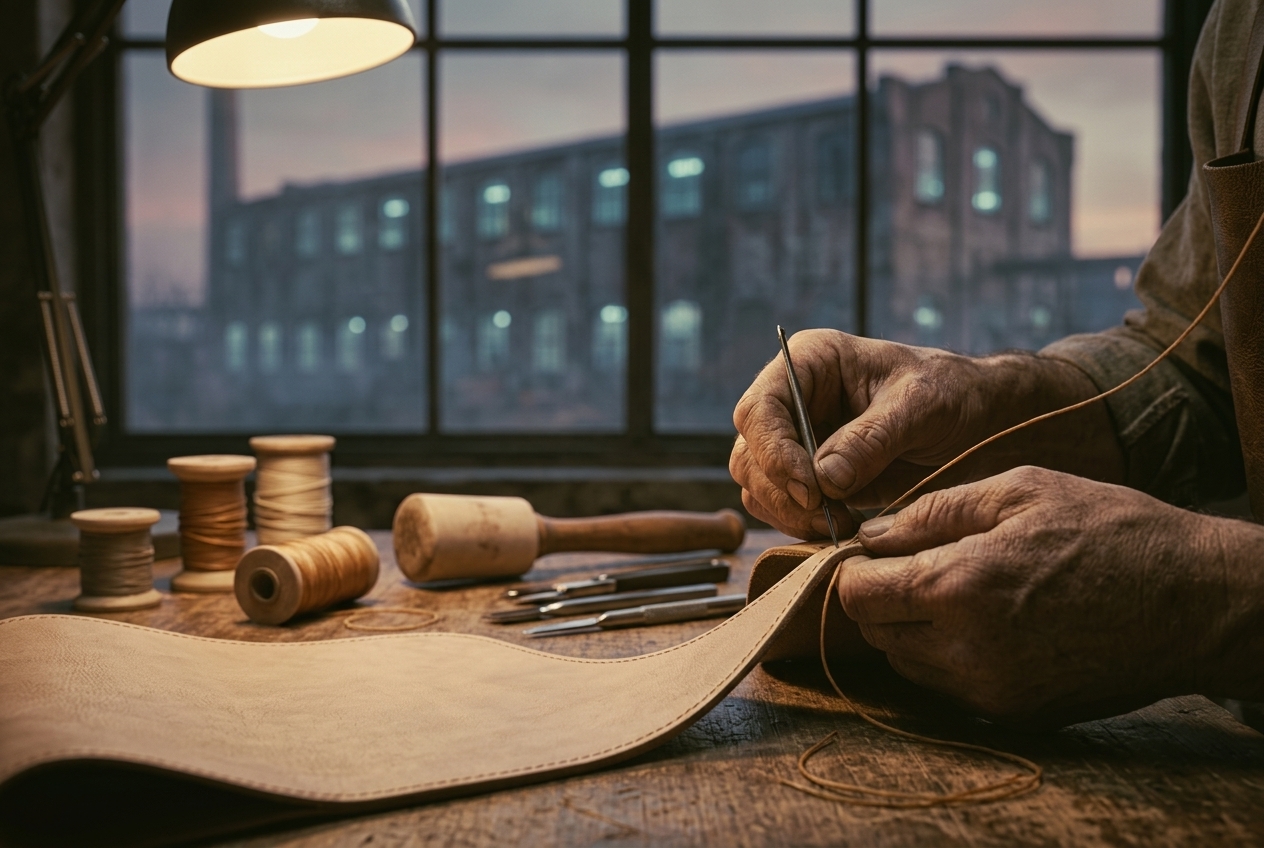
Sheila Loewe, president of the Loewe Foundation, has been saying versions of the same thing for a decade: craft is cultural heritage, the skills are dying, and losing them is a one-way door. “There are very important skills that have already been lost forever,” she said this year, presenting the fourteen-judge panel’s choice of the South Korean ceramicist Jongjin Park for the Foundation’s 2026 Craft Prize — €50,000 and a silver trophy, drawn from 5,100 entries, for a seat-like form in slip-cast, porcelain-coated paper called Strata of Illusion. “At Loewe, we are all in love with craft, and we want to make it contagious.” (Wallpaper*) The prize has run since 2016, funded by a company whose own origin story, retold on its own website this anniversary year, is a small leather workshop opened in Madrid in 1846 (Loewe). It is, by every visible measure, a serious and well-run institution for saying that hands matter.
Two of Loewe’s sibling houses inside LVMH spent the last two years finding out, from a different kind of institution, what happens when somebody actually goes and checks whose hands. In June 2024 a Milan court placed Manufactures Dior under judicial administration after police found four of its Lombardy subcontractors running unsafe, undocumented workshops. A parallel inquiry by Italy’s competition authority, opened over whether Dior’s ethical marketing claims had misled shoppers, closed in 2025 after Dior agreed to spend €2 million over five years identifying victims of labour exploitation (Peters & Peters). In July 2025 a Milan court put Loro Piana under administration too, after inspectors found workers sleeping in the dormitories that made its cashmere and vicuña goods, no fire exits, and one worker hospitalised after being beaten for asking to be paid (Glossy); that administration was lifted early, in April 2026, the court satisfied the supply chain had been cleaned up (Modaes).
Dior and Loro Piana are two of five Milan luxury manufacturers placed under judicial administration since 2024 — along with Alviero Martini, Giorgio Armani Operations and Valentino’s Bags Lab — and thirteen more houses, among them Prada, Gucci, Versace, Dolce & Gabbana and Yves Saint Laurent, are reportedly now submitting compliance plans to Milan prosecutors rather than risk being next (SGI Europe). The judges who put Armani under administration in April 2024 did not treat what they found as a rogue supplier: “irregular practices so deeply rooted and established that they can be considered part of a wider business growth strategy,” they wrote (Daily Sabah). One contractor making bags for Valentino, inspectors found, was producing them for €35 to €75 each; the finished bags sold for €1,900 to €2,200 (The Fashion Law).
What the prize and the court are actually testing is not the same thing, however identical the vocabulary. The Loewe Foundation’s fourteen judges reviewed a portfolio and a finished object; the standard is whether the work is good. The Milan court reviewed seven workshops, electricity meters logging production through the night and public holidays, and a hospital record. A panel of design critics and ceramicists could not have produced the second kind of finding if it had wanted to, and nobody has proposed that it should — which is worth noticing on its own, since the two processes share a word and share, two floors up, a balance sheet. The Foundation calls itself, without apparent irony, an institution “in love with craft”; nothing in its charter obliges it to go looking at what its housemates’ subcontractors are doing at two in the morning. That was never its job. It only ever had the one.
It would be unfair to the actual craft revival to file it under the same heading as any of this. The Somerset House and Shoreditch shows Dezeen covered this week, and the growth of London Craft Week from roughly 35,000 visitors a decade ago to something near 250,000 now, are mostly the record of people trying to keep a technique alive at a loss. “Few of my peers are making money exclusively from selling objects and furniture they’ve made,” the designer Andu Masebo told Dezeen (Dezeen). That population — underpaid, visible, proud of the object in front of them — has almost nothing in common with the workers sewing through the night in a Lombardy shed except a label a marketing department is happy to put on both.
Sheila Loewe says the skills she’s worried about are already lost forever. Nobody at the Milan court found a craft skill missing at Dior or at Loro Piana — the stitching, by every account, was fine. What both administrations found missing, in two separate buildings owned by the same company, was somebody whose job was to go and look.
Sources
Zoe Whitfield, “Loewe Craft Prize 2026 winner announced,” Wallpaper*, 2026.
“180 Years of Craft History,” Loewe.
“Dior subsidiary placed under special measures following discovery of exploitation in supply chain,” Peters & Peters.
“Inside the Loro Piana scandal: Labor abuse, court oversight and the myth of sustainable luxury,” Glossy.
“Loro Piana Freed from Judicial Supervision as Italy Addresses Labor Abuse Accusations,” Modaes Global, April 2026.
“Milan prosecutors target 13 luxury brands over labor exploitation,” SGI Europe.
“Italian court puts Armani under receivership over exploitation,” Daily Sabah, April 2024.
““Made in Italy” Handbags Face Scrutiny in New Valentino Case,” The Fashion Law.
Debika Ray, “How craft conquered design,” Dezeen, 16 September 2026.