“Alive to colour, light, and shimmering motion, Monet uniquely captured a mood and a moment in a world that never held still. A century on, his work asks us to slow down, notice each carefully placed brushstroke and dash of colour, and find the world more vivid for it.”
It reads like wall text, but it was written by Sasha de Marigny, Chief Brand and Communications Officer of Anthropic, on the occasion of her company being named a supporting sponsor of Tate Modern’s first Monet exhibition, opening 25 February 2027. Monet: Painting Time is curated by Juliet Bingham and Genevieve Barton, led by Morgan Stanley in its fiftieth-anniversary London year, and backed further down the list by Anthropic, the Huo Family Foundation, and the usual supporters’ circle. Tate’s own curators don’t reach for that word either: the exhibition’s own framing says Monet “echoed the rapid pace of modern life by capturing the fleeting, instantaneous ‘impressionist’ moment.” A brand statement and the scholarship funding it are already disagreeing before the doors open.
The scholarship has the better of it. In the autumn of 1890 Monet began the grainstacks: a hillside outside Giverny, the same two or three stooks of wheat, painted over and over until the following spring. He did not work on one canvas at a time and wait for conditions to repeat. His stepdaughter, Blanche Hoschedé, hauled out as many canvases as her wheelbarrow could carry, and he moved between them, “working on whichever canvas most closely resembled the scene of the moment as the conditions and light fluctuated” — as many as ten or twelve in a single day, each one given the few minutes its particular effect actually lasted before the light moved on and made it wrong. If you are shopping among dead painters for a working method that matches shipping several new answers to the same question within a single week, this is a defensible pick. It is just not the artist the sponsor’s paragraph describes.
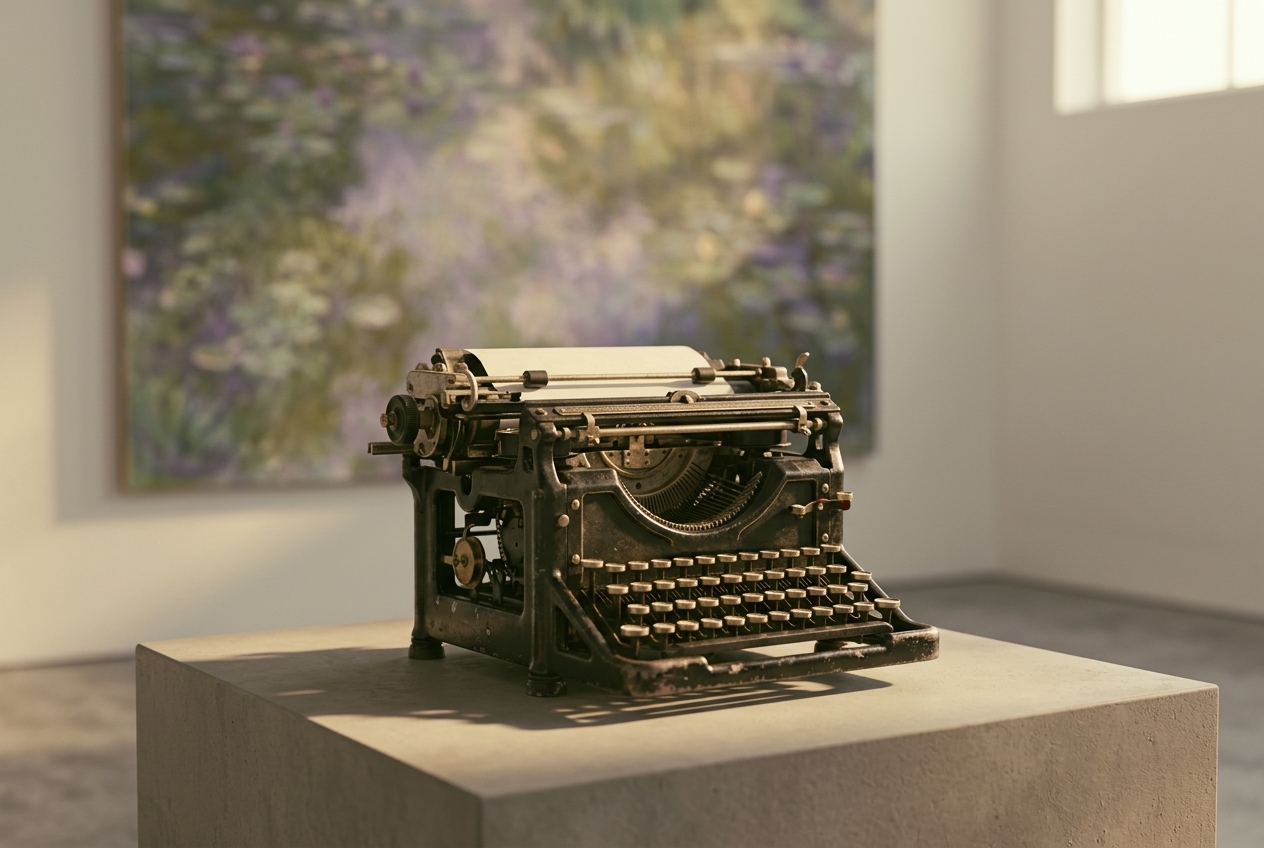
This is not Anthropic’s first Monet this year. It was lead sponsor of “Monet and Venice” at the de Young in San Francisco, which closed in July, and that show had something London isn’t getting: a physical installation where a visitor could type a question and watch Claude answer it, letter by letter, on the keys of a vintage machine. The engineer who built the thing, Ben James, didn’t build it for a museum. He wired a Brother AX-10 electric typewriter to an Arduino and a Raspberry Pi, intercepting the keyboard so that whatever gets typed goes to Claude’s API and whatever comes back gets typed onto the paper by the machine itself — a project he describes, in his own account, as motivated by curiosity rather than use: “seeing an LLM physically manifested is quite compelling,” watching it “whir and clunk into life” felt like “rediscovering LLMs for the first time.” Anthropic found the hack and, in James’s own words, “turned my clunky AI typewriter into a beautiful installation,” where visitors could “ask Claude about Claude (Monet)” and query the museum’s archive through it.
Tate has confirmed to the Art Newspaper that there are no plans for anything similar in London. I don’t think that’s squeamishness about gadgets. I think somebody looked at the typewriter and noticed what it actually does, which is perform a wait that isn’t happening. The keys clack for exactly as long as the answer is long, but the answer was complete the moment the question landed; nothing is being discovered letter by letter the way a canvas genuinely was, minute by minute, on a hillside in 1890. A grainstack painted in four minutes still recorded four real minutes nobody could get back. The typewriter’s four seconds of clacking are theatre laid over a process that took a fraction of one, dressed in the furniture of a machine built for a world where a hard return meant a lever physically striking something.
The Tate announcement went out on 17 September. Eleven days earlier, in a single week, Anthropic released two models of its own, Claude Fable 5.1 and Claude Mythos 5.1, while Meta shipped Muse Spark 1.3, Google shipped Gemini 3.8 Flash, and OpenAI shipped GPT-6 Astra — a week CNBC covered under the headline “model fatigue”, quoting Runpod’s CEO, Zhen Lu, on “so much frothiness,” and Sam Altman conceding, without apparent objection, that “we’re all moving to faster cadences.” Gartner puts global AI spending this year at $2.59 trillion, up 47 percent on 2025. The company paying to be associated with a painter who “asks us to slow down” had, eleven days before it said so, just had one of the faster weeks of its own history.
The San Francisco show is over and its typewriter went with it. London gets the tidier version: no visible machine, no letters arriving one at a time, just a paragraph in a list of supporters, asking an audience to notice brushstrokes. It reads better than the typewriter did. It is also the version with nothing left in it you could actually go and watch answer a question.
Sources. The Art Newspaper, 17 September 2026; Tate press release, “Monet: Painting Time”; Tate Modern exhibition page; Fine Arts Museums of San Francisco, “Monet and Venice”; Ben James, “Ben by Fax,” on converting a typewriter into a Claude terminal; Ben James on X; Wikipedia, “Haystacks (Monet series)”; CNBC, “‘Model fatigue’ sets in as AI labs race to roll out new versions at frenetic pace,” 6 September 2026.