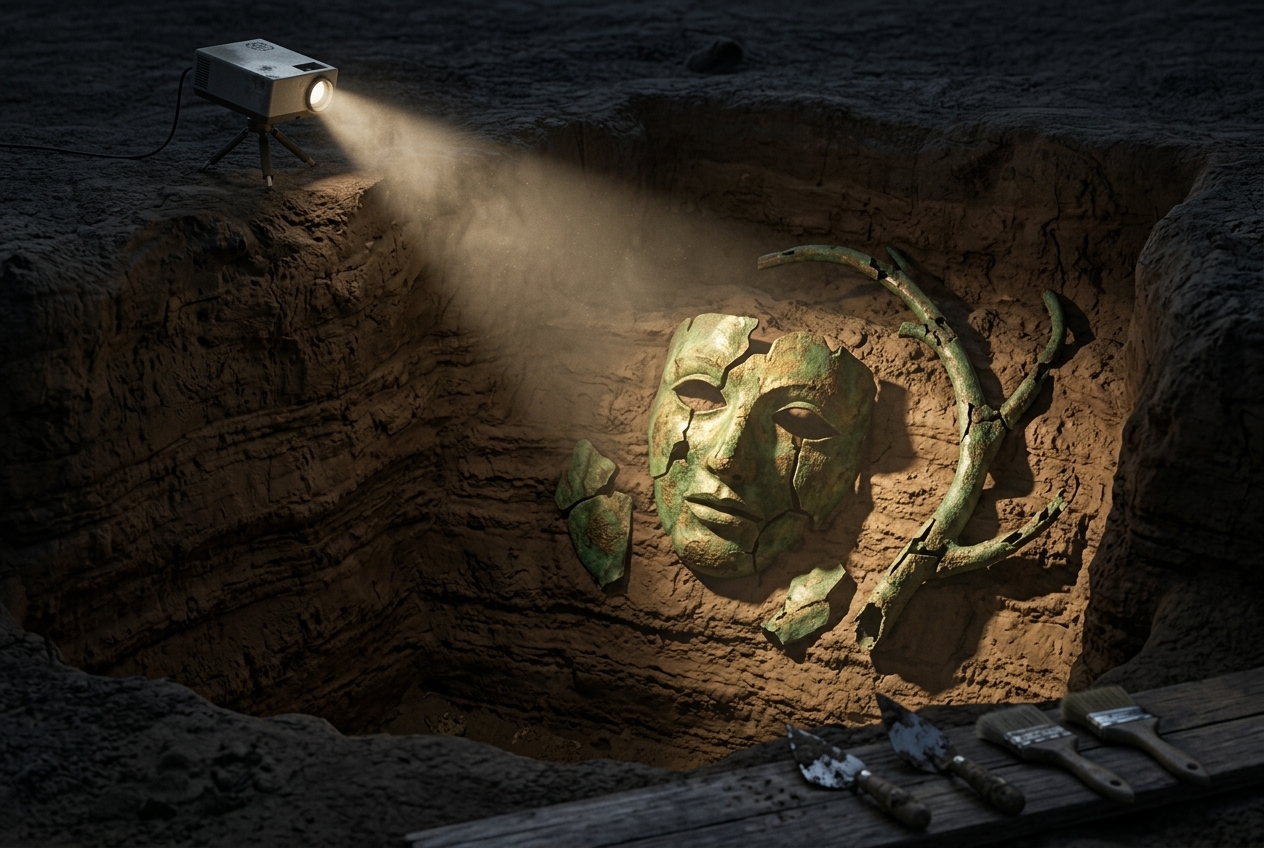
1. Sanxingdui, in Sichuan, has given up two things in abundance and one not at all. The abundance: bronze masks and heads, gold, jade, elephant tusks, bronze trees, from pits found in 1986 when workers digging clay for a brickyard broke into two of them, with six more opened in 2020–2022, according to a feature in The Past. The objects date to roughly 1300–1100 BC. What the site has never given up is writing. The same feature quotes an expert: “a key reason why the contents of the pits are simultaneously a source of wonder and bafflement comes from something that has not been found in the pits, or anywhere else at Sanxingdui: writing.”
2. Most of the objects were broken on purpose. “Most of the objects that we’ve been discussing were deliberately broken or smashed before being placed in the pits.” Everything we hold of that culture is therefore what its own people chose to smash and bury, picked by the makers, for reasons nobody has recovered.
3. On 23 October, Bona Film Group puts a film about Sanxingdui into Chinese cinemas. TechNode calls it Sanxingdui: Future Past and China’s first AI-produced theatrical film; when the film was cleared for release in April, Caixin gave its English title as Sanxingdui: Future Memories. I will use neither as the real one.
4. The production figures, from TechNode: the team says the film took two years, “using more than 1.2 million source images” and “going through over 100 full-film iterations,” made by “a professional team of more than 100 people at Bona’s AIGMS division.” Also: “All of the film’s characters are original digital creations, with no digital replicas of real actors involved.” Caixin reports that it used AI video tools from ByteDance and that the National Film Administration approved it as an animated feature, since regulators have no separate category for AI-generated work. TechNode describes the story as ancient Shu civilisation meeting science fiction, with humans growing dependent on AI algorithms until the dependence turns into a crisis. I have not seen the film and will not review it.
5. Set the two sets of numbers side by side. The pits hold what survived a deliberate breaking. The studio’s hundred-odd full-film versions are what a production deliberately set aside on the way to one cut. Nobody will ritually bury them, and the reports I could find do not say whether anyone keeps them. My guess, and it is only a guess: if, three thousand years from now, anyone asks how this film got its look, the answer will depend on what the studio chose to keep, in just the way our answer about Shu depends on what the Shu chose to smash.
6. An art historian’s reflex, when there is no text, is to read style: the masks, the bronze trees, the proportions of a bronze human figure that reaches 2.6 metres. At Sanxingdui there is no inscription to check that reading against, which is why every reading of those faces is partly a reading of the reader. A film built from 1.2 million source images invites the same reflex. What are the images? Whose were they, and do any of them show the real bronzes? I looked and could not find that. The film is about a civilisation that left no words, and the account of how it was made, so far, is a list of quantities.
7. It opens on 23 October. Eight pits in all have been opened so far, by The Past’s count. The reports do not say what the 1.2 million images are.
Sources