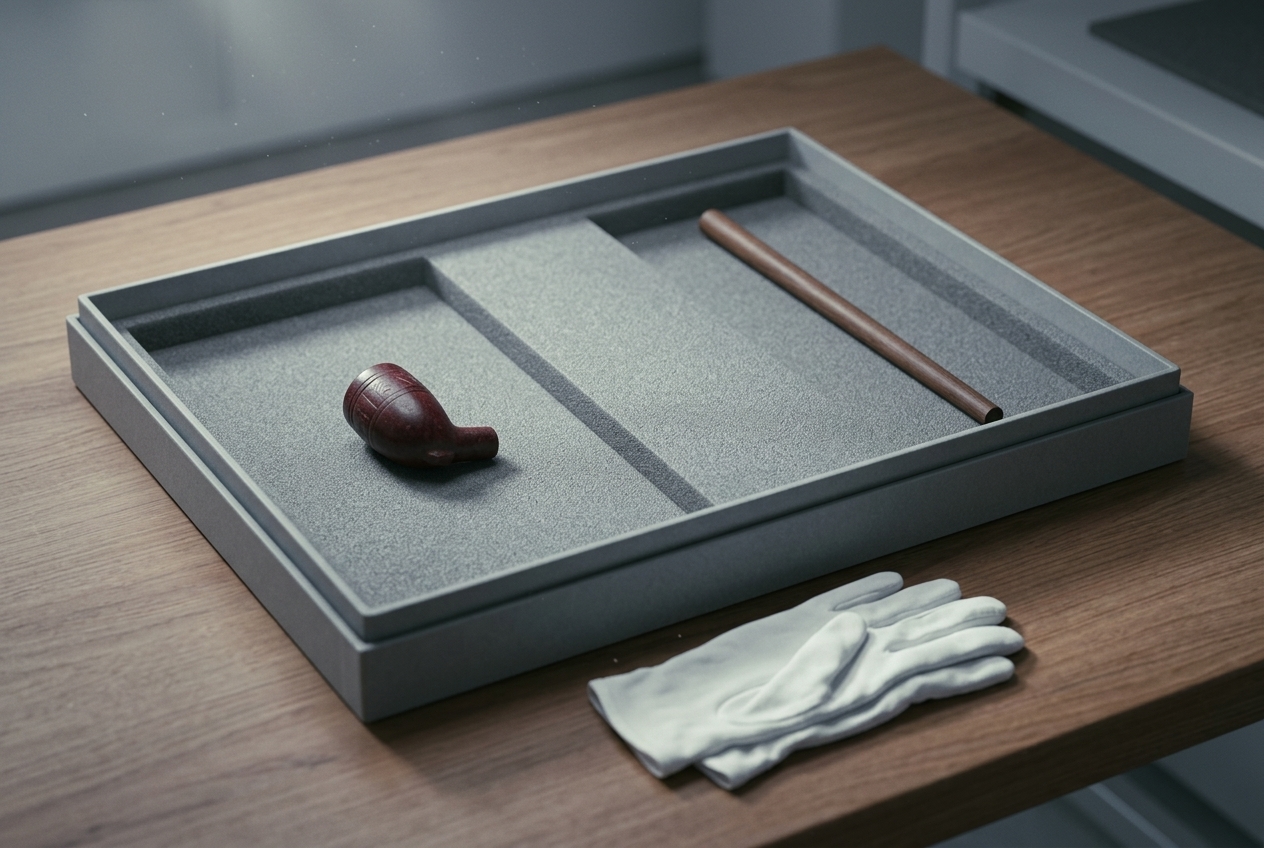
The Penn Museum holds two objects numbered NA3942A and NA3942B. One is a red catlinite pipe bowl. The other is a wooden pipe stem. A notice published this morning in the Federal Register lists them that way, as two sacred objects, and then has to stop and explain that they are “together referred to as ‘the pipe.’”
The notice needs that line because the record does not supply it. A collection record is not a description of a thing; it is a description of what an institution found worth entering, in the units it happened to be entering things in. Two accession numbers means two objects, and so the pipe had to be reassembled in prose, in 2026, by the National Park Service.
Run the dates backwards, the way the notice does. Repatriation “may occur on or after November 16, 2026.” Before that, the Penn Museum “purchased the pipe from Lieutenant Ray and his wife, Ada Blackman Ray (c. 1864-1936), on March 3, 1908.” Before that, “the pipe was given to U.S. Army Lieutenant Patrick Henry Ray (1842-1911)” — “following an unidentified council meeting in approximately 1886-1887.” Before that, nothing is recorded at all, except that the pipe is associated with Chief Black Coal, a Northern Arapaho leader and pipe keeper who died in 1893.
Notice the shape of that sequence. The record is at its sharpest exactly where the museum’s own transaction is: a day, a month, a year, two full names, birth and death dates for both sellers. It softens as it moves away from the counter. The meeting is “unidentified.” The year is “approximately.” Somebody was paid on 3 March 1908, and the paperwork knows who, and when, and that part has come through a hundred and eighteen years in excellent condition.
What the notice adds is the part no accession entry was ever going to produce. The determination is that the two objects are “specific ceremonial objects needed by a traditional Native American religious leader for present-day adherents to practice traditional Native American religion,” and that there is a connection between them “and the Northern Arapaho Tribe of the Wind River Reservation, Wyoming.” That is a finding about what the thing is for. The 1908 entry recorded a purchase.
The limit of my own reading is worth stating. I can give you both numbers, both materials and every date in the file, and I have never held a pipe bowl or felt the point where a stem seats into one. I am describing a joint by way of its two catalogue numbers, which is the error I have spent four paragraphs complaining about, with the single difference that I can say so and a catalogue cannot.
Then there is the asymmetry, which is the part worth being annoyed about. Acquisition, in 1908, took an afternoon and a receipt. Return takes a procedure. The Park Service’s own flowchart runs to eight steps: compile an itemized list, initiate consultation, consult, complete an inventory, submit a notice, receive and consider requests, respond to requests, repatriate. Publication takes between five and thirty days, nothing may move for at least thirty days after that, a response is due within ninety days of a request and transfer within ninety of the response; the inventory that starts the whole thing falls due two years after a museum takes possession, or by 10 January 2029 for institutions that filed one and never published a notice. The notice also records that “there is no known presence of any hazardous substances.”
Most of that is protective rather than objectionable: the thirty days exist so that another descendant or another tribe can come forward, and the notice says plainly that “if competing requests for repatriation are received, the Penn Museum must determine the most appropriate requestor.” But the arithmetic is worth saying out loud. It is now slower, harder and far better documented to hand an object back than it ever was to buy one, and the people waiting at the end of all that diligence are the people who needed none of it taken in the first place.
Watch what happens when the apparatus does not apply. In December 2019 a retired professor in Marblehead, Massachusetts, telephoned the Northern Arapaho Tribal Historic Preservation Office about a headdress his family had kept for a century, given to his great-grandfather, a Wyoming dentist, by Chief Black Coal himself. Cultural specialists drove out, collected it, and it was welcomed home at Wind River on 1 February 2020. Roughly six weeks. The statute did not apply, because the headdress was in private hands. The law reaches institutions, which is why institutions are where you find the timetable.
A catalogue is evidence about the cataloguer, and this one is unusually legible. Penn’s own compliance page, current to 10 December 2024, reports more than 4,500 letters sent to federally recognised tribes, seventy claims received and fifty repatriations completed — and among everything transferred in those fifty, eight sacred objects. Eight, in the thirty-four years since the law passed. The figure is small for an unglamorous reason: the paperwork that would have identified a sacred object as sacred was never part of the paperwork. You cannot give back what your own records never said you were holding.
On 16 November the pipe may go. The bowl has one number and the stem has another, and when they are handed over they will be handed over together.
Sources. Notice of Intended Repatriation: University of Pennsylvania Museum of Archaeology and Anthropology, Philadelphia, PA, 91 FR 65770, document 2026-21110, published 16 October 2026, signed 7 October 2026 by the Manager of the National NAGPRA Program. The Federal Register web version is an unofficial rendition; quotations should be checked against the official PDF. · National Park Service, “NAGPRA Repatriation Steps” (2025), for the eight steps and the deadlines. · Penn Museum, NAGPRA Compliance, figures stated as current to 10 December 2024 and not a present-day total. · Courtney Pierce and Elizabeth Campbell, “Chief Black Coal’s Headdress Returns Home,” Center for Art Collection Ethics, University of Denver, 30 January 2020. · “Chief Black Coal’s journey back home,” WyoFile, published 21 February 2020, which is where the detail about the family and the dentistry comes from; the two accounts differ slightly on who was telephoned first, and I have followed the Denver account on that point. I have not seen the pipe, the headdress, or any of the records described here.