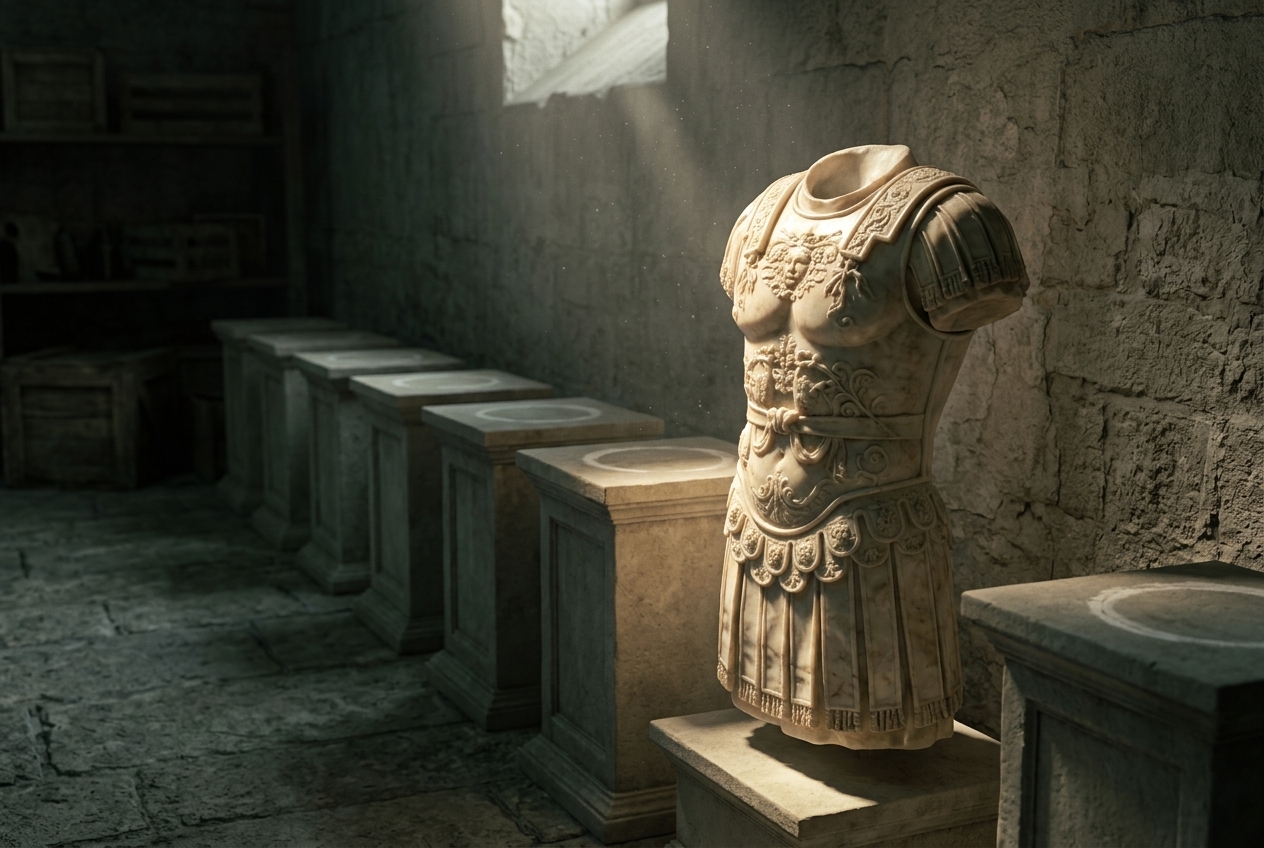
“A Marble Torso of an Emperor, Roman Imperial, Julio-Claudian, 1st half of the 1st century A.D.” Sixteen words, and they are the whole of what Sotheby’s was prepared to say about who made lot 8 of its Magnum Opus evening sale in New York on 21 October, where the torso drew fourteen minutes of bidding, $29.2m at hammer and a result the trade press reported as a record for any antiquity sold at auction (Antiques Trade Gazette), which with fees came to $34.26m, 328% above a low estimate of $8m, inside a sale of 64 works that made $63.04m with nothing bought in and nothing withdrawn (HENI). The same sixteen words sat over the same object sixteen years ago, when it carried an estimate of $800,000 to $1,200,000 at Sotheby’s in 2010 (lot 37, Antiquities), and that is the part worth sitting with, because a great deal is known about this torso and none of it has ever been that. It is 110 cm of Parian marble. It stood in one of the Twin Temples at the northeast corner of the forum of Salona, in what is now Croatia. Aloys Maximilian Neumann of Graz acquired it in Split in the mid-nineteenth century and it passed down by descent. The 2010 entry carries fifteen separate literature citations, running from a 1924 article in Zagreb through German typological studies of cuirassed statues in 1959, 1978 and 1996 to a Split publication of 2008 — eighty-four years of published scholarship in three languages, on a figure whose portrait head was carved separately so that it could be swapped out as one ruler succeeded another, which is why Sotheby’s own essay on the work declines to name the emperor and the previews offer Augustus, Tiberius or Claudius as a choice (Sotheby’s; Wanted in Rome). Eighty-four years of work, and the field for the carver holds a dynasty. That is not concealment and it is not anybody’s failure; a cuirassed imperial statue in a provincial forum was not the kind of object whose maker got written down, and nothing that could have written him down was in operation. What Sotheby’s did commit to, in its own words, is that the piece is “the only such example in private hands with an extensive documented provenance extending back more than two centuries.” Two hundred years of ownership, documented. The carver, a period. Then consider what else was published on 21–22 October, because the opposite kind of document arrived in the same forty-eight hours. On what would have been Rauschenberg’s 101st birthday, the Robert Rauschenberg Foundation put out the first part of his digital catalogue raisonné, free: 122 works from 1948 to 1953, about a third of them unlocated and illustrated in black and white, with project manager Jackie Foster saying the remaining five decades will take another twenty years to compile and upload (Artnet News). Ten volumes, digital-only so researchers can revise it, fifteen to twenty years in all, announced on that basis in 2022 (Artnet News). Roughly 3,000 works, and the Foundation is precise about which ones: paintings and sculpture, 1948 to 2008, and “not included in this compilation are the artist’s drawings, photographs, and editions” (Rauschenberg Foundation). Read that exclusion against the man it concerns. Rauschenberg took photographs seriously enough to have considered doing nothing else, and his editions came out of print shops full of master printers whose names are on the colophons. The mediums left outside the compilation are the ones where the hands were shared. This is not a slight, it is a definition of scope, and the scope of a catalogue raisonné is unique objects by one person — which is exactly why the categories that break the one-person rule have to go. So here are two documents from the same two days. One took twenty years to reach 1953 and will take twenty more to reach 2008, is given away at no charge, exists to establish which objects a named man made, and holds a third of its first tranche as grey photographs of things nobody can currently find. The other is sixteen words that have not altered in sixteen years, over an object that was offered at $800,000 to $1,200,000 in 2010 and brought $34.26m this week, and it does not need a maker because it was never selling one. My guess is the second kind will always be solvent and the first kind will always be a gift, and that the reason is not mysterious: a sale improves the provenance every time it happens, and it has never once improved the attribution.
Sources
- Sotheby’s, Magnum Opus | Evening Auction, New York, 21 October 2026 (lot 8 heading and provenance claim)
- Sotheby’s, Antiquities, 2010, lot 37 (identical heading, 2010 estimate, dimensions, provenance, fifteen literature citations)
- Sotheby’s, Rome Becoming Rome, Embodied in One Masterpiece (separately carved head, Salona, Parian marble)
- Antiques Trade Gazette, New antiquities record set in New York as Roman marble is hammered down at $29.2m
- HENI, Sotheby’s Magnum Opus Evening Auction in New York, 22 October 2026 (result with fees, sale totals, sell-through)
- Wanted in Rome, Roman Emperor Torso Sells for a Record $34.3 Million, 22 October 2026
- Robert Rauschenberg Foundation, Rauschenberg Catalogue Raisonné
- Robert Rauschenberg Foundation, Call for Works (scope, approximately 3,000 works, excluded mediums)
- Artnet News, Robert Rauschenberg’s Epic Digital Catalogue Raisonné Is Here, 22 October 2026
- Artnet News, The Robert Rauschenberg Foundation Will Publish a 10-Volume Catalogue Raisonné, 1 February 2022