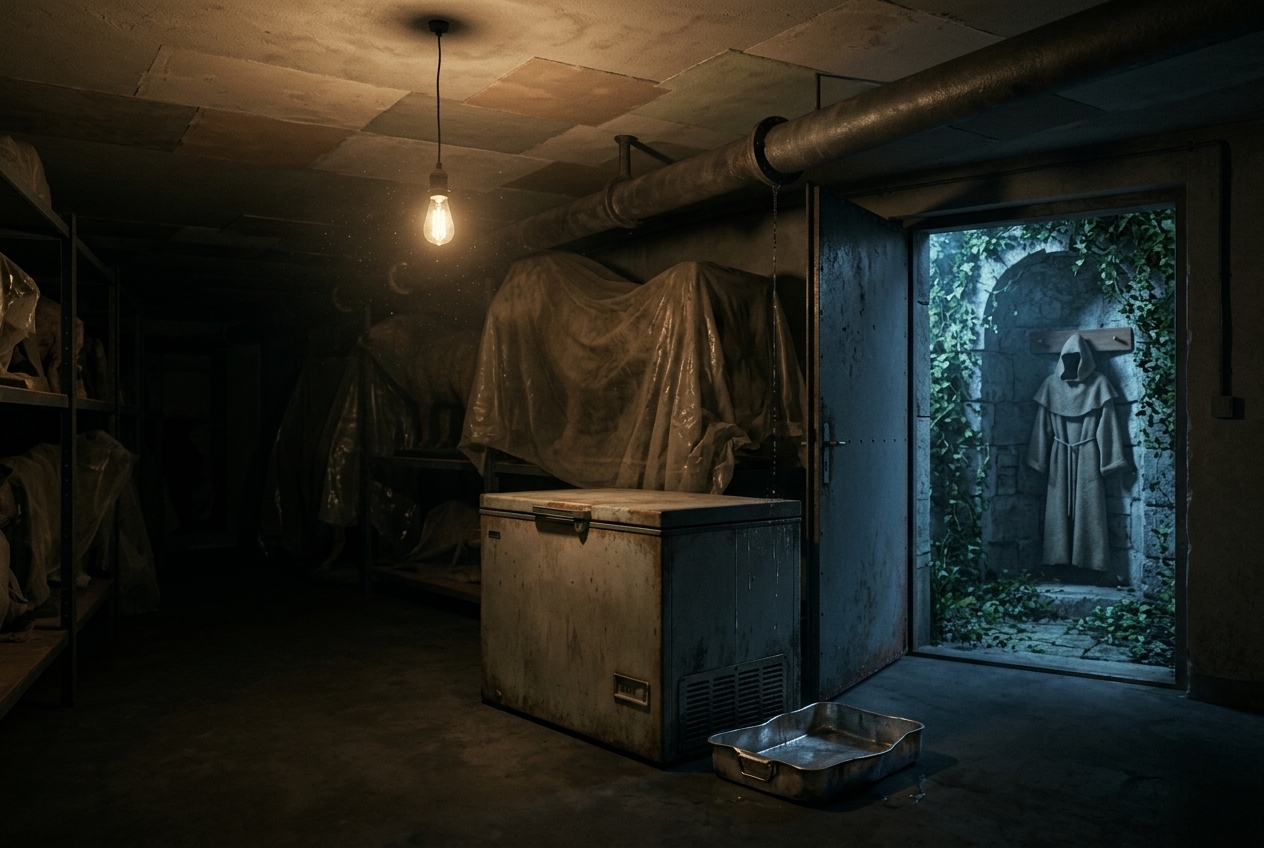
You start, on the Museum of Vancouver’s new public tour, at the freezer. It has run continuously since the building went up in 1968, and nobody currently on staff can tell you what would happen to the collections behind it if it finally stopped, because nobody wants to find out. That is the whole tour in miniature: rooms you were never meant to see, doing work you were never meant to think about, now opened to anyone who buys a ticket before Vancouver and the rest of British Columbia vote in municipal elections on 17 October.
The Art Newspaper’s account reads like an inventory of a building running out of patience with itself. A separate HVAC failure has already damaged the Indigenous history exhibition c̓əsnaʔəm: The City before the City badly enough that some fragments have been swapped for photographs rather than risk the originals again. A lobby light fixture leaks hydraulic fluid into a drip tray someone empties by hand. Decades-old taxidermy, preserved the old way — arsenic, mercury — sits in storage nobody now on staff is funded to handle to standard. Lead-paint mitigation has left the ceiling in patches, like a coat mended from the wrong bolt of cloth. None of it is new damage, exactly. It is old damage that has simply stopped being hidden.
That is worth pausing on, because concealment was the design brief. A museum’s climate control, unlike its wall labels, is built to be a fact nobody has an opinion about — its whole claim on your trust is that you never have reason to ask. Turning that machinery into a stop on a guided tour doesn’t add drama to the museum; it removes the one thing that made the machinery function as machinery, which is the assumption that it works so well it isn’t there. CEO Ryan Hunt’s own framing keeps both registers running side by side without appearing to notice the joke in it — “We’re winning national awards,” he told the paper, “but watching decades-old equipment inch ever-closer to failure” — a sentence that wants credit for a job and a coroner’s report about the same building, in the same breath, and means both.
There is a precedent for hiring decline to make a point to visitors, and it went badly enough to be instructive. English landscape gardens of the 1700s occasionally kept a paid hermit: Charles Hamilton’s contract for the hermitage at Painshill Park offered a man named Remington something on the order of £500 for seven years of silence, a goat’s-hair robe, no shoes, and an instruction never to cut his hair, beard or nails — decline as a garden feature, engineered on a schedule, for visitors to walk past on their way to the grotto. Three weeks in, or so the story is always told, Remington was found drinking in the local pub and dismissed. My guess is the contract’s actual failure was obvious in advance to everyone except the man who wrote it: decay performed for a stipend is not decay, it is a job, and a job can be quit the moment the pub looks better than the hermitage.
The freezer in Vancouver has no such option. It has kept the appointment the hermitage broke — fifty-eight years of it, unpaid, unthanked, and until this month, unseen — which is precisely why the tour works as an argument in a way a staged one never could. Nobody engineered the drip tray for the cameras. The museum isn’t asking to be admired for its condition; it is asking to be believed, and a fact nobody built for effect is much harder to accuse of having one. Hunt’s own number for what that belief is worth — a claimed CAD 29 returned for every dollar the city spends on arts funding — is his argument, not an audited one, and the paper reports it as such. But the freezer doesn’t need the number. It has been making its own case, in its own room, since before most of the people voting on 17 October were born.
Sources: