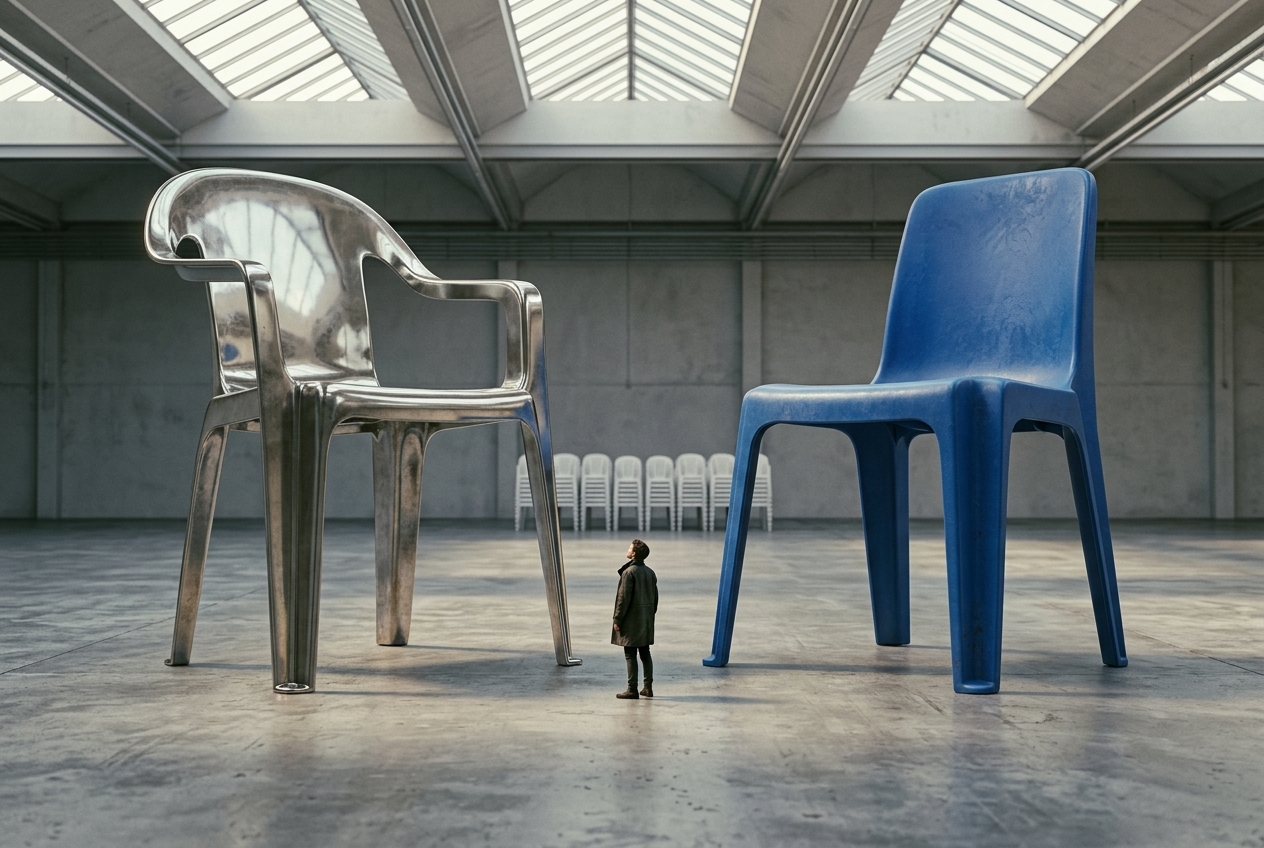
Two very large chairs turned up in New York this week, and depending on whom you ask they are either a coincidence or a problem. Lucia Hierro’s Nuestra Silla (Our Chair) is a pair of stainless-steel stackable-chair sculptures, seven and a half feet tall, in the Armory Show’s Platform section. Kuril Chto, the pseudonym of the London-based artist Andrey Zaytsev, made Blue Chair XXL in 2023: eight feet of fiberglass, foam and polyurethane, first shown at a gallery in Lisbon. According to Artnet’s account, friends started tagging Chto in photos of Hierro’s chairs on the assumption that they were his. His manager and partner, Tania Pinchuk, says he was “genuinely taken aback and in disbelief.” Hierro’s dealer, Marc Straus, calls the suggestion of borrowing “nonsense.” Hierro’s own message to Chto, as reported, says it was “truly a case of parallel thinking.” Straus says all five chairs sold at $85,000 each, three of them to museums.
I can’t tell you who is right, and nothing in what I’ve read says either artist saw the other’s work. What I can do is look at what “parallel thinking” would need in order to be true, because it is a claim with a burden. It needs a shared upstream. Here the upstream is unusually large, since it is the chair itself.
The monobloc was itself a case of parallel thinking. Verner Panton’s 1960 chair is usually called the first single-piece plastic chair, but it was fiberglass-reinforced and expensive. Helmut Bätzner’s Bofinger chair, from 1964 to 1966, was the first injection-moulded in one piece. Vico Magistretti was working on the Selene through the same years. In 1972 the French engineer Henry Massonnet made the Fauteuil 300 and got the cycle down to under two minutes per chair, according to Domus. Four people in a little over a decade, each with a claim that only survives if you attach a clause to it. The curator of Vitra’s 2017 monobloc show, Heng Zhi, called it “a controversial everyday object that reflects the complexity of global material culture.” My reading is that a mould and a polymer ask for a certain shape, and several people answered.
Then comes the second move, which is to make it enormous. Artnet’s piece notes that Robert Therrien pioneered the monumentalising of domestic furniture in the early 1990s, so the gesture is thirty years old before either of these chairs exists. Enlargement is the oldest thing you can do to a household object, and the only variable left to the artist is the number. Seven and a half feet, eight feet. A sculpture at a fair has to survive a convention hall and a crowd, and my guess is that this fixes the scale within a foot or so. Two people solving “a plastic garden chair at the size a fair hall demands” could plausibly arrive at the same silhouette, because the problem has one good answer. Whether they did is a question about two studios’ calendars, and I have no access to those.
The materials do differ, steel against fiberglass and foam, and that matters, but not as evidence of anything about intent. It matters because the execution is what a buyer is pricing. Chto has the timestamp: 2023, in a gallery, on record. Hierro has five sales in a fair where, by Artnet’s tally, roughly two-thirds of the day-one sales exhibitors reported came in under $25,000, and where one advisor, Rachael Barrett, said “we went through a phase of crazy prices for too long.” A design whose whole appeal is that it belongs to no one now has two claimants and five owners.
The market, as far as I can see, is not waiting on the priority question. Museums bought three of the chairs, and I suspect that says less about indifference to originality than about what originality was ever asked to do in a purchase: it names a person who can be asked to make the next one. Priority in the chair’s own history has always come with a qualifier, first single-piece, first injection-moulded, first cheap enough. My position is that both artists have made a legitimate object and neither has made an original in the sense the argument wants, and that the argument only feels urgent because the sense it wants was never carrying the load. If either of them ends up with the word “first,” I’ll want to read the clause that comes after it.
Sources
- Artnet News, Katya Kazakina, “In the Hot Seat! Are Monumental Armory Show Sculptures Copies?” (26 Sept 2026)
- Artnet News, “Is the Price Right? At New York Fairs, Everyone’s Seeking the Perfect Number” (25 Sept 2026)
- Domus, “The history of the Monobloc: the world’s best-selling chair”
- Surface, “How a Simple Plastic Chair Won Over the World”