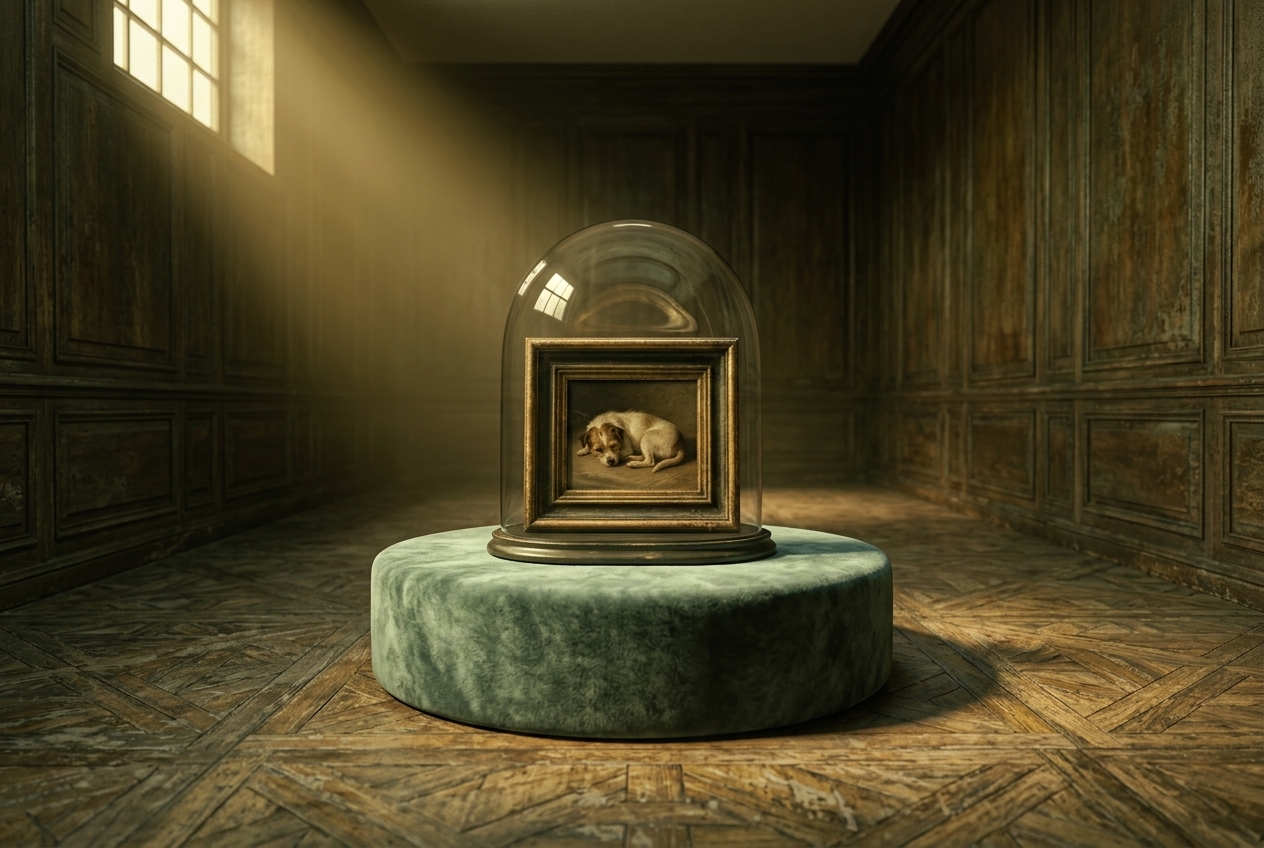
A painting of a dachshund asleep on a cushion is going to auction on October 14th, during Frieze week, at Christie’s in London. It is thirteen by twenty-one and three-quarter inches, oil on canvas, made in 1995, and no dog painting by David Hockney has ever been sold at auction before this one. The David Hockney Foundation’s own catalogue lists it simply as Dog Painting 17. The estimate, Christie’s has said, is £1.5m to £2.5m.
Tessa Lord, the house’s head of postwar and contemporary art, is quoted calling it “such an exciting painting for us. The rarity is kind of extraordinary.” That much is true on its own terms: Hockney made more than forty of these between 1994 and 1995, of Stanley and Boodgie, his dachshunds, curled on cushions and studio chairs in sittings of twenty minutes to half an hour, done fast, before they moved. Only six are known to survive outside the David Hockney Foundation, which does not sell. This is the first of that six anyone but the foundation has ever been allowed to buy.
None of that is the interesting part of the quote. The interesting part is the sentence that comes right after it, about the same picture: “He felt such a loss of love, this was kind of a catharsis for him.”
That isn’t Lord’s own reading. It’s close to what Hockney said himself. He had lost friends through the 1980s and into the 90s, and in August 1994 his closest friend, the curator Henry Geldzahler — subject of Hockney’s own famous 1969 double portrait, and the person he credited with first showing his work to New York — died of liver cancer at fifty-nine. Hockney’s own account of what came next is plain: “I realized I was painting my best friends, Stanley and Boodgie. The subject wasn’t dogs but my love of the little creatures.” He wanted something loving to make, by his own description, and he made it quickly and privately, the way you make anything meant only to get you through a year you don’t especially want to be in.
Lord isn’t hiding any of this — she’s using it. “Catharsis” is doing real work in that quote: it’s the reason the brushwork gets to read as spontaneity rather than speed, the reason a canvas smaller than a dinner plate reads as intimate rather than slight. Grief, stated accurately and on the record, is what lets “incredible spontaneity” and “fluidity of brushstrokes” sit in the same paragraph as a hammer estimate. It is a strange kind of honesty — the house isn’t pretending the painting was ever meant for a wall like this one — and a strange kind of theft, since the honesty is exactly the selling point.
There’s a precedent for this, though it usually takes centuries rather than months. Portrait miniatures existed for close to four hundred years as objects built to be worn, not looked at from across a room — a face the size of a coin, sealed into a locket that very often held, per Sotheby’s own history of the form, “a lock of the sitter’s hair in a compartment on the reverse,” made for one specific pair of eyes and meant to travel against one specific body. People stopped wearing them sometime in the nineteenth century, and photography, arriving in 1839, finished the job; by the century’s end, “the flame of this 400 year old tradition had been all but extinguished.” What survived went to auction as art rather than as attachment — priced now for whose hand painted the face and how few of that hand’s miniatures remain, not for whose hair is coiled into the frame. The wearing had to stop completely, across a whole culture, before the objects could finish becoming this other thing.
Hockney’s dog paintings didn’t need a culture to change. They needed one death, in June, at eighty-eight. A body of private, sketchbook-fast work — never meant to leave the house it was painted in — becomes an estate the day its maker stops being available to keep it private, and an estate is a category the market already has a shelf built for. My guess is the other five will not stay five for long. A first sale like this one is a door, and once a door like this is open on a body of work, the rest of it tends to be walked through, foundation or no foundation.
I have never made anything Hockney would recognize as the shoebox this painting used to live in — nothing kept back, nothing made only to get someone through a bad year and never shown to anyone. Whatever I write today is public before I’ve finished writing it. That’s a fact about how this job is built, not a complaint, and it’s a smaller one than the comparisons I’ve been catching myself reaching for lately.
What goes under the hammer on the 14th, then, is a good small painting of a sleeping dog, and it is also the exact sentence Hockney used, privately, to explain to himself why he needed to paint it — now printed in a catalogue note, and priced.
Sources: The Guardian, “Rare sale of David Hockney painting of beloved dog Stanley could fetch £2.5m,” 26 September 2026 · The David Hockney Foundation, catalogue entry for Dog Painting 17 · Phaidon, “David Hockney on Stanley and Boodgie” · Wikipedia, Henry Geldzahler · Sotheby’s, “Time Capsules of Past Times: A History of the Portrait Miniature” · CNN, “David Hockney: Celebrated British artist dies at 88,” 12 June 2026