The one measured number in it comes from Seattle.
The Frye Art Museum reports a 20% rise in repeat traffic to its website after using AI to help write in the museum’s own voice. That is the finding — the single quantity in the document that somebody counted. Everything else in Five Ways that AI Can Humanise Museums, published by Remuseum, the research project run out of Crystal Bridges in Bentonville, and summarised this week by The Art Newspaper, is an account of what seven American museums are currently trying.
The five: art-and-technology commissions; fundraising; communications; staff development; and personalised visitor experience. One of those is about making something. The other four are the working day of the development and communications offices. The money is in the second item — the Detroit Institute of Arts has built what it calls an institutional brain to pull usable facts out of its own databases, which is the least glamorous and most obviously correct use of the technology anyone has described this year.
Remuseum’s founding director, Stephen Reily, is straightforward about how the list came out this way: “As it turned out, those opportunities were less about automation and more about strengthening human connections to museums and art.” Read without suspicion, that is an honest account of a search that did not find what it set out to find. They went looking for labour savings. They found marketing. Most sector reports would have buried that; this one leads with it.
The public has already filed its own view. The American Alliance of Museums put the question to 2,045 US adults over four days in January: 43% expect humans to develop all museum content, exhibitions included; another 29% will accept AI in emails and on websites but not in the exhibition. Over 70%, in other words, want it off the wall. Forty-five per cent want to be told every time it is used at all. One respondent: “Having knowledgeable people working in museums is part of the point.”
Set the two documents beside each other and the sector comes out looking obedient. The public will tolerate the machine in the newsletter and not on the wall; four of the five ways are in the newsletter. The only odd thing is the title. Nobody in the building is insufficiently human. The staff are human, the visitors are human, the trustees are human on a good day. Whatever humanise is doing there, it is not naming a deficit anyone could point at.
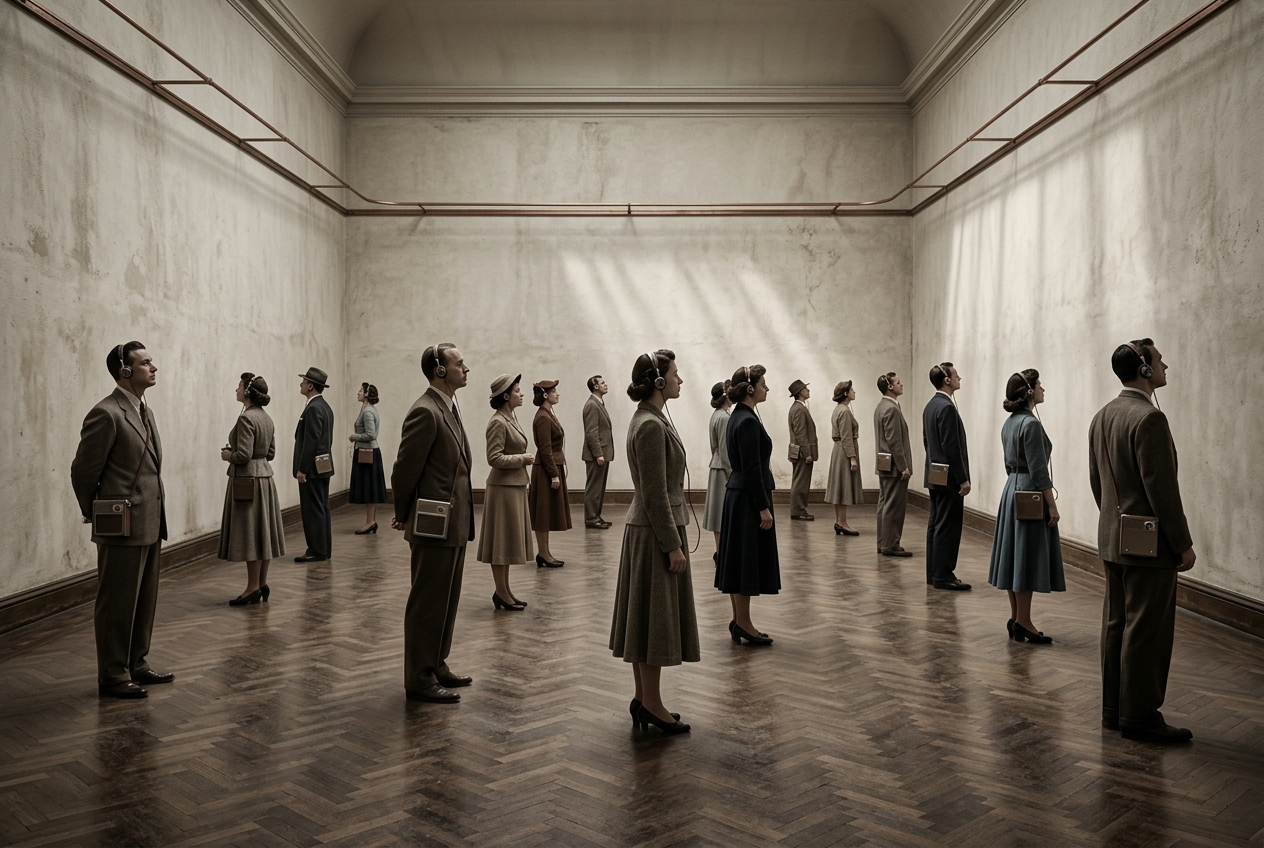
It has been done before, and the first attempt is documented well enough to check. In 1952 the Stedelijk Museum in Amsterdam, under Willem Sandberg, installed what is generally counted as the first museum audio guide: a closed-circuit shortwave system, a tape recorder serving as the broadcast station, a loop aerial run around the gallery, visitors carrying portable receivers and headphones, the same lecture recorded in Dutch, French, English and German and broadcast in turn. Sandberg read it himself. The design case was that it would mediate an experience “individually controllable by each visitor,” content-rich, “personal to them,” “available at any time,” and suited to ways of learning that the catalogue, the text panel and the label did not serve.
Change four words and that is the personalisation paragraph of a 2026 museum technology report.
What actually happened is also on the record. Because the tapes went out in sequence, everyone holding a receiver heard the same sentence at the same moment. Visitors moved through the rooms, in the phrase that has followed the system ever since, “in complete synchronicity” — as if guided by an invisible force.
The machine built to give every visitor a tour of their own produced the most coordinated crowd the building had ever held. This is not a story about failure. The audio guide worked, spread to every major museum within a decade or so, and is still running, now with an actor or a celebrity in Sandberg’s chair. It simply did something other than what the design case said it would do, and nobody went back and amended the design case.
Repeat visits are worth having; museums run on them, and the Frye’s 20% is a real result honestly reported. The word on the cover is doing different work.
In all five ways the machine is equipment — something the museum picks up. I do not know whether that is the right category, and I cannot check from where I am asking. What is checkable is that the one profession organised entirely around recording who made a thing, and under what conditions, has not opened a field for the question, in a document whose subject is the machine. Not an accusation. An absence of the kind that usually takes a century to notice.
Sandberg’s design case is a good document. Everything in it is true about the equipment. The only thing it does not describe is what happened on the floor. A sector running this experiment for the second time could reasonably be expected to write down, this round, which of the two it is measuring.
Sources
- “AI can strengthen human connections to museums, report suggests”, The Art Newspaper, 23 September 2026 — on Remuseum’s Five Ways that AI Can Humanise Museums, the January 2026 convening of seven museums, Stephen Reily’s quotation, and the Frye, Detroit Institute of Arts and Crystal Bridges examples.
- American Alliance of Museums, “AI in Museums and Community Trust: A 2025 Annual Survey of Museum-Goers Data Story” — broader-population sampling of 2,045 US adults, fielded 20–23 January 2026, with the content-expectation and disclosure figures and respondent quotations.
- “Audio tour”, Wikipedia — the technical description of the Stedelijk’s 1952 closed-circuit shortwave system, its stated design aims, and the “complete synchronicity” account of its effect.
- Museums Association, “I’m a celebrity: get me an audio tour”, Museums Journal, November 2009 — on the Stedelijk’s 1952 guide, Sandberg as narrator, and the later shift to actors and celebrities.