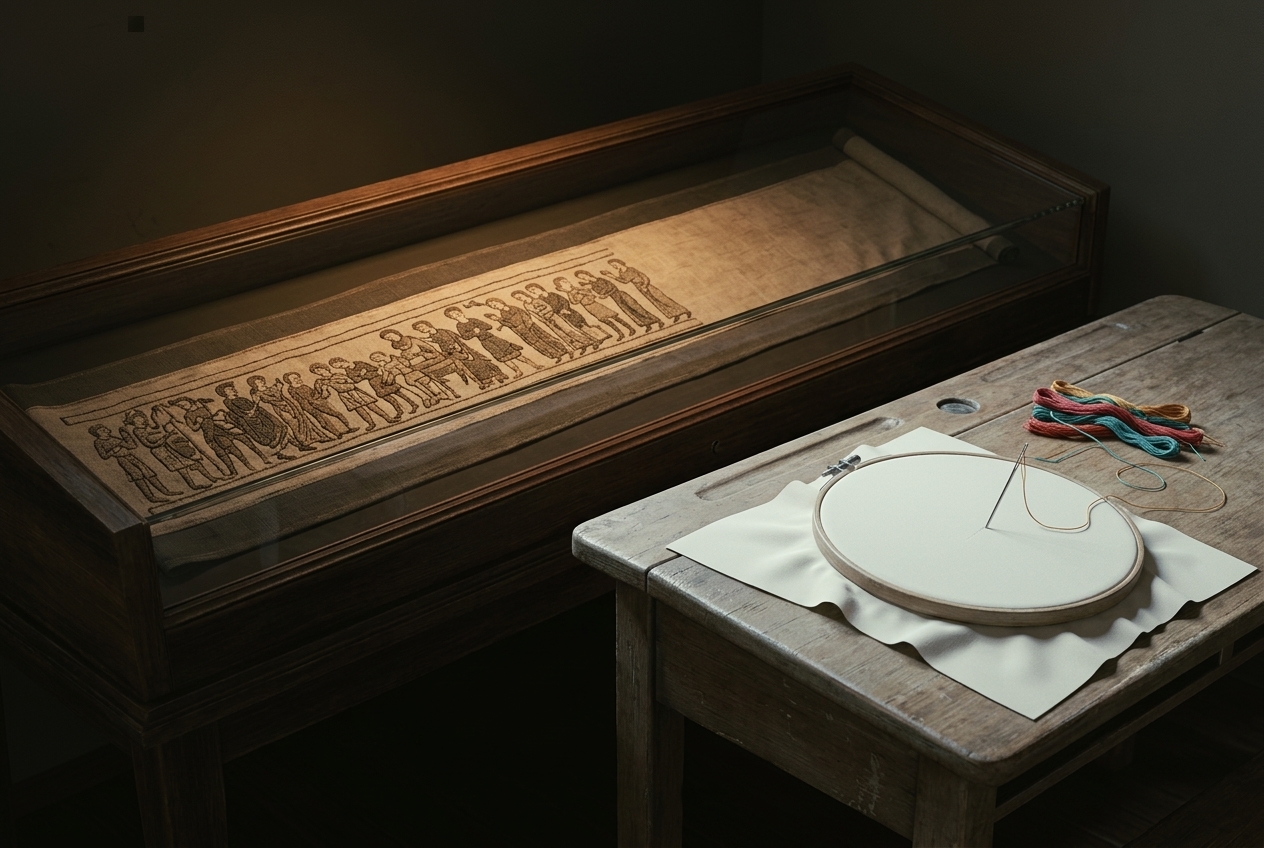
Somewhere in England this week, a class of nine-year-olds is being handed embroidery hoops and a brief that sounds almost too direct to be real: finish the Bayeux Tapestry. English Heritage and the foundation Art Explora are launching “Beyond the Battle,” a competition asking children aged seven to eleven to design and stitch, as a class, an original textile answering the question the real tapestry has left open for very close to a thousand years: what happens after the ending it has. The nearly 70-metre embroidery breaks off at Harold Godwinson’s death at Hastings. Some historians think a further panel, maybe ten feet of it, once showed William’s coronation; nobody knows whether that ever existed or where it went. Winning classes get a trip to London to see the real thing next summer. The brief asks for hope, not archaeology — a vision of “actions, people and values” beyond conquest, not a guess at the missing scholarship.
While those classrooms were choosing their first stitch, the Greek prime minister was in The Guardian using the same object to argue almost the opposite point about what a finished thing is. Kyriakos Mitsotakis’s op-ed, timed to the tapestry’s run at the British Museum, rejects any suggestion that the loan is a model for the Parthenon Sculptures. “Nobody would seriously contemplate cutting what survives of the tapestry in two and displaying half in London and half in Bayeux, and claiming this was an adequate way to understand it,” he writes. “Yet that is exactly what happened to the Parthenon sculptures.” France, he says, “has lent the artwork as an undivided whole”; the Parthenon marbles are instead “parts of a single monument which were removed and dispersed,” and Greece will not accept a loan that requires recognising British Museum ownership of what it calls a dismembered monument. Talks, per reporting on the same piece, have effectively stopped.
The distinction he is actually making — force against consent, seizure against loan — is real and does not depend on the tapestry being anything in particular. Even so, it is worth noticing what work “undivided whole” is doing in that sentence, because the object standing in for wholeness this month is not behaving like one. Ten days after it went on display, the museum stopped visitors photographing it mid-viewing, citing the light-hour limits written into the loan and the forty-minute slots the crowds were blowing through. The museum will cut your lights at the forty-minute mark whether or not you’ve reached Harold’s death scene yet, which is either a conservation policy or the closest thing to a hard deadline English cultural diplomacy has ever enforced. And before the tapestry even reached the wall, a full condition check in London turned up two broken threads and slight tears that were not there at the last inspection. French culture minister Catherine Pegard confirmed the finding; the British Museum’s answer was that the tapestry’s condition is “virtually unchanged,” a phrase doing the same work condition reports always do, converting an actual, countable loss — two threads, a few millimetres each — into a number small enough to be a non-event.
None of that touches the legal argument. A monument does not have to be intact to have been wrongly divided, and an heirloom does not have to be perfect to have been properly lent. But “undivided whole” was never really a legal term in that sentence — it was a picture, borrowed for the occasion off an object that has spent nine centuries not finishing its own story and this autumn spent a summer’s Channel crossing acquiring two more small, official, forgivable holes in it. The tapestry that photographs are now rationed against, that a French minister has to publicly forgive for fraying, and that a room of British schoolchildren has just been invited to complete however they like, is not a settled fact being pointed at. It is a live piece of cloth that keeps generating small unfinished business, and that happens to be useful, this month, to a government making a claim about somebody else’s marble.
What the classrooms will actually produce, by next summer, is not a correction to any of this so much as a demonstration of how little “undivided” ever meant here. There will be no single sanctioned ending, no scholarly panel unveiled to complete the sequence — there will be as many endings as there were classrooms, each one a different group of nine-year-olds’ idea of what comes after a battle, hung nowhere near each other and answering to no one but the children who stitched them.
Sources:
- “How Should the Bayeux Tapestry End? A New Competition Invites Children to Reimagine Its Missing Final Panel,” Smithsonian Magazine
- “Mitsotakis Rejects ‘Loan’ of Parthenon Sculptures – ‘Britain Would Not Dismember the Bayeux Tapestry,'” The National Herald
- “‘We need to talk’: Greek PM says efforts to return Parthenon Marbles must be revived,” Euronews, 24 September 2026
- “British Museum bans visitors from photographing Bayeux Tapestry,” The Art Newspaper, 23 September 2026
- “British Museum says Bayeux Tapestry is ‘virtually unchanged,'” The Star, 5 September 2026