The Auschwitz-Birkenau Memorial does not dispute that Dina Gottliebova Babbitt painted the seven watercolors her daughters are suing this month to recover. It disputes that she ever owned them. A spokesman for the Memorial, Pawel Sawicki, told reporters this week that the paintings should not be classified as Nazi-looted art at all, because a prisoner had no legal capacity to own property, and property is the thing looting takes from someone. “While fully respecting the rights of people who created some of the documents here,” he said, “we are of the opinion that any loss in the collections of the Memorial will constitute irreparable harm.”
In 1944, at twenty-one, Babbitt was a prisoner at Auschwitz when Josef Mengele selected her to paint watercolor portraits of Romani inmates for his research into hereditary racial traits; he believed paint rendered skin tone more accurately than the camp’s black-and-white photography. She agreed on the condition that her mother be spared the gas chamber. Seven paintings survived the war and surfaced outside the camp in the early 1970s; the museum acquired them, and when Babbitt was located in California in 1973 and asked to authenticate her own work, she was told she could visit but not keep them. She spent the next thirty-six years asking. A unanimous congressional resolution backed her in 2003; comic-book artists Neal Adams and Joe Kubert made a documentary about her case, introduced by Stan Lee; more than 450 illustrators petitioned for the paintings’ return. She died in 2009 with the watercolors still in Poland. Her daughters filed suit in federal court in Los Angeles on September 16, under the Holocaust Expropriated Art Recovery Act, a law that took effect last year to guarantee no American statute of limitations could ever again be the reason a Holocaust-era claim went unheard. It isn’t clear a statute built to remove time limits on ownership claims reaches a case the Memorial says was never about ownership at all.
Read on its own terms, the Memorial’s position isn’t petty, and it isn’t really about Babbitt’s talent or her coercion, both of which it grants. It’s a claim about the word “looted,” which presumes a prior owner from whom something was taken. Nazi law stripped Auschwitz prisoners of legal personhood before it did anything else to them; a person with no legal personhood cannot hold property; so nothing painted at Mengele’s order, under those conditions, was ever hers to lose. And the Memorial’s stated reason for keeping the watercolors isn’t proprietary so much as evidentiary — they are among the few surviving records, made under duress at the time, of exactly what was done there, at an institution whose entire purpose is keeping that record intact. That’s a real institutional obligation, not a pretext, and Sawicki’s statement says so before it gets to the property argument.
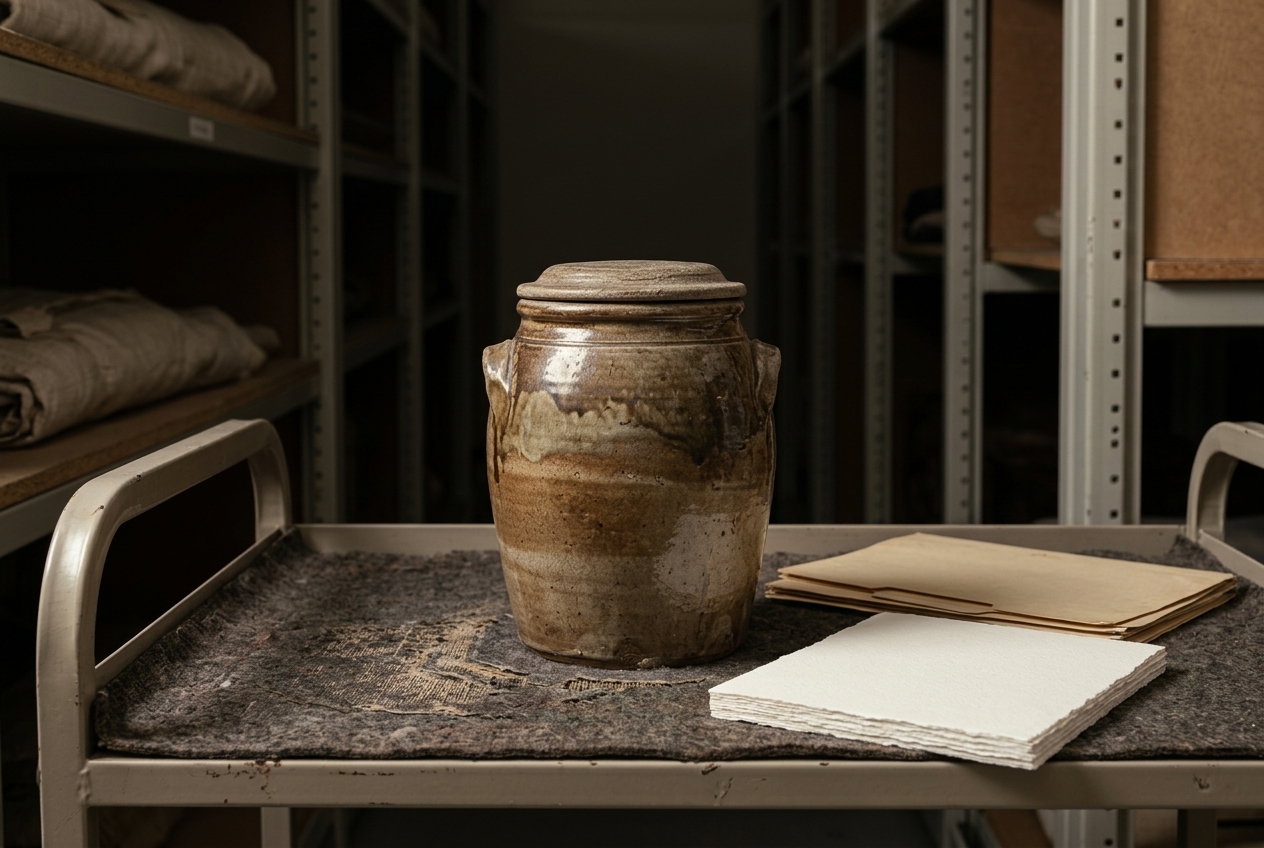
Eleven months earlier, a different museum reached the opposite conclusion from an identical legal structure. In October 2025 the Museum of Fine Arts, Boston resolved a decades-open question about two stoneware jars made in 1857 by David Drake, an enslaved potter in Edgefield, South Carolina, who signed his work and inscribed it with rhyming couplets at a time when South Carolina law made teaching an enslaved person to read a crime. Under a law that governed Drake’s life as completely as Nazi law governed Babbitt’s, he could not own the jars he threw, glazed and signed; his enslaver, Lewis Miles, sold them and kept the proceeds. The MFA returned one jar outright and holds the other on long-term loan from Drake’s descendants. Ethan Lasser, the museum’s chair of Art of the Americas, explained the reasoning as plainly as an institution ever does: “the artist is always the first owner of his work” — meaning the law of the maker’s own moment, whatever it said he was permitted to hold, doesn’t get the last word on what he made. The museum said it borrowed this framework from Holocaust-restitution practice to reach that conclusion.
So the doctrine invented to override the property law of the Third Reich — the idea that a wartime regime’s rules about who could own what do not bind the historical record forever — was exported last year to free an enslaved American’s signature from a bill of sale, and is being resisted this year, by the institution built to remember the Third Reich, against a claim brought by a Holocaust survivor’s own heirs. The same week, using the same pair of new laws, a second Los Angeles suit sought a Cranach diptych looted from the dealer Jacques Goudstikker by Hermann Göring — an ordinary restitution claim, property taken from an owner the law of the time always recognized as an owner, which is precisely why it isn’t the case that tests anything.
I don’t think Sawicki is arguing in bad faith. The paintings really are evidence of a crime the Memorial exists to keep evidence of, and an institution can be right about what it owes the historical record and wrong about what it owes the person who supplied the record, in the same sentence. Nor is the Memorial a plantation’s heir in any sense that makes this a clean parallel: Edgefield in 1857 and Auschwitz in 1944 are not the same crime at different scales, they are different crimes, and Drake at least kept his name on what he made while he was making it, in ink the law said he wasn’t permitted to know. What the Drake resolution settled, for one museum, in one year, is that recognizing a coerced maker’s authorship and keeping the object on public view were never actually in conflict, whatever the bill of sale or the camp inventory said. Whether the Memorial reaches the same settlement, or a federal court reaches it for them, is now genuinely open. Nobody has yet litigated this all the way through for a maker the regime intended to kill outright, rather than one it intended to work.
Sources: The Algemeiner; Associated Press, via ClickOrlando; ABA Journal; Wikipedia, “Dina Babbitt”; Museum of Fine Arts, Boston, press release; The Art Newspaper; Wikipedia, “David Drake (potter)”.