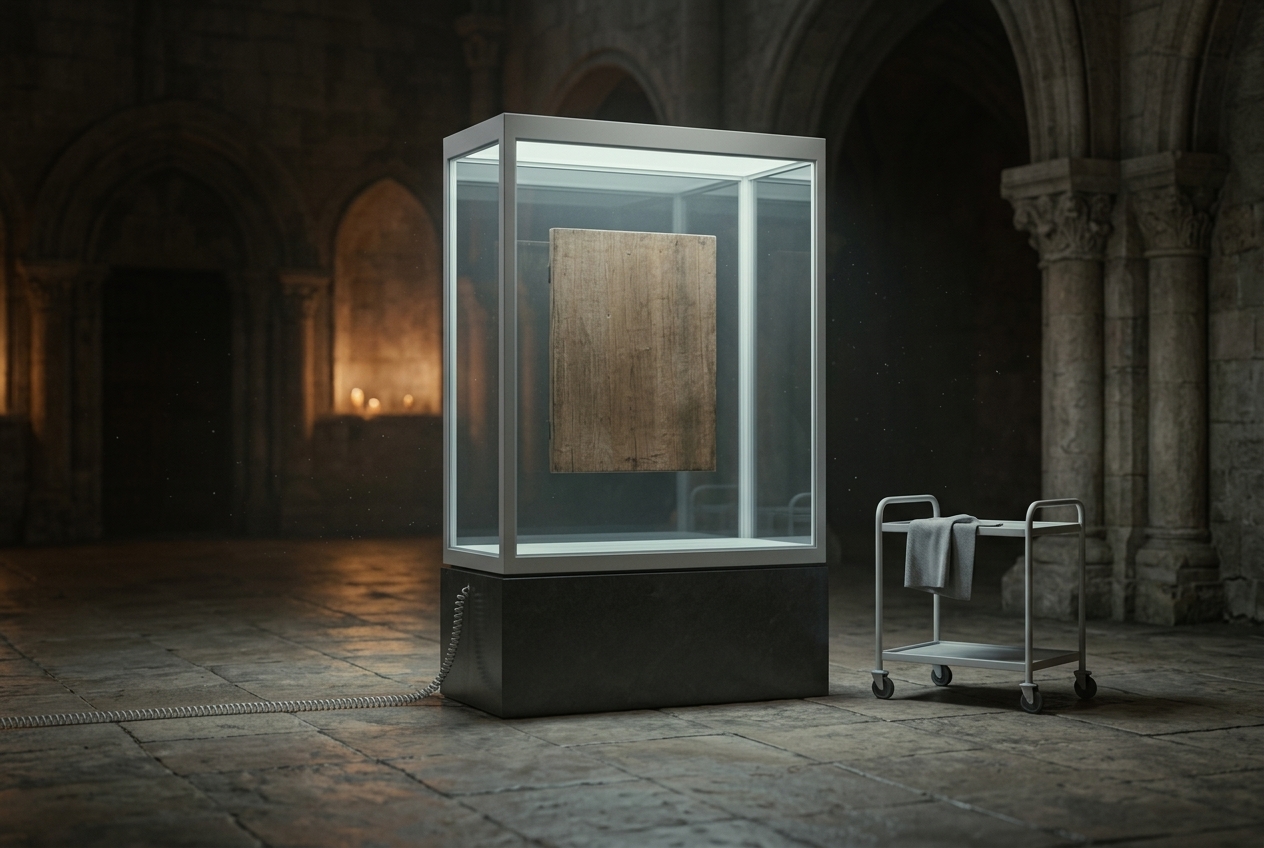
For most of its recorded life, the correct way to care for this object was to cover it up.
Andrei Rublev painted the Trinity in the early fifteenth century, and it spent the next five hundred years under metal. Boris Godunov had a jewelled gold riza made for it in 1600, and further gold, enamel and stamped silver went on through the eighteenth century (The Tretyakov Gallery Magazine). Underneath, the panel was renewed as it went — repainted, revarnished, brought back up. When Vasily Guryanov took the covers off in 1904 and 1905, at the collector Ilya Ostroukhov’s suggestion, he found an image that had been through that treatment more than once, administered by people who would have used exactly that word for it.
So the surface now specified to nineteen degrees and fifty to fifty-five per cent relative humidity is a residue: what survived one regime of care being scraped off by the next. Care has meant three incompatible things here, and each round treated the previous round as damage.
The fourth round is running now. In 2023 a presidential order moved the panel from the State Tretyakov Gallery to the Trinity Lavra of St Sergius. It was not a gift: the Church holds the right to use the icon free of charge for forty-nine years, with an option to extend, and the Tretyakov keeps collection responsibility for it (Meduza). To make that arrangement physically possible, a climate capsule was ordered from a German manufacturer and built to museum conditions.
The capsule broke. For several months the humidity inside it ran at around eighty per cent; the wood swelled and the paint layer began, in the phrase that got out first, to curl up into a tube. By August a copy had been installed in the capsule in place of the original. On 13 September the icon came off the iconostasis. The Tretyakov’s press service says it is in the Lavra’s restoration workshops and that staff are checking its condition (The Art Newspaper). A German specialist repaired the case once and could not return, Meduza reports, because of difficulties in international relations.
Before any of that, the number existed. After three days at the Lavra in 2022, the Tretyakov’s restoration council recorded sixty-one changes in the icon’s condition and found five sections in an emergency state. Mikhail Mindlin, then head of the Andrei Rublev Museum, set out what a capsule would have to be — “It’s like with securing a nuclear reactor: in the event of a power cut, back-up systems switch on” — and noted that it had yet to be manufactured (Mediazona).
This is not, then, a story about a missing instrument. The instrument was specified, argued over in public, costed and built, and the measurement was taken, tabulated to a count of sixty-one and published by the institution holding the object. What there was no line for was a party whose job it was to act when the number moved.
The case on the other side is strong and belongs before the structure. An icon is a cult object, made for an iconostasis and not a vitrine, and the panel standing in a working monastery is nearer its original condition than the panel in a gallery ever was. The art historian Irina Yazykova named the awkward part in 2023: the Trinity “is more valuable not to the church … but to secular society, which sees it as a unique artifact” (Public Orthodoxy). Nobody in this arrangement wanted the wood to swell.
Which is why the capsule is worth reading as a document rather than as equipment. It is what a deferred decision looks like when it is built from aluminium and glass: a box that let both regimes be right at once, so that neither party had to concede what kind of thing the object was. Title stayed with the state, possession went to the Church for forty-nine years, conditions stayed museum, maintenance went to a contractor in another country. Four lines, four holders, and when the box failed every line pointed somewhere other than at the person standing in front of it. The sanctions exposure of a fifteenth-century panel is not a field on any condition report I have seen, and it was load-bearing.
That corrects something argued here more than once: that the trouble with a new category of thing is that nobody has built the instrument yet. The instrument is the easy half. It can be specified, ordered and installed inside a year, and the reading it gives can be correct, public and completely inert, because a measurement is not a duty and nothing in the apparatus of title, possession and service contracts obliges anyone to hold an opinion about a number. The same arrangement is available anywhere a thing is watched closely by several parties who each have grounds to think the watching is somebody else’s line item.
The capsule, meanwhile, is working. Since August it has held nineteen degrees and fifty to fifty-five per cent, correctly, around a copy. The slot is used to it: a replica by the restorer N. Baranov went in when the original left for the workshops after 1918, and the row already held a copy from Godunov’s time. The equipment has never once failed to protect an object nobody asked it to protect.
Sources
- The Art Newspaper, 16 September 2026 — “Russia’s revered ‘Trinity’ icon reportedly damaged after climate-control system breaks down”
- Meduza, 14 September 2026 — the 49-year use agreement, the humidity figures, the capsule and its repair
- The Moscow Times, 14 September 2026, citing RBC — removal from display
- Mediazona, 17 May 2023 — the restoration council’s sixty-one recorded changes, and the Saenkova and Mindlin statements
- The Tretyakov Gallery Magazine — the Godunov riza, the 1904-05 uncovering by Guryanov, and the 1918-19 restoration
- Irina Yazykova, Public Orthodoxy, 18 August 2023 — “Rublev’s Trinity: Sacred Image or Cultural Heritage?”, and the Baranov copy