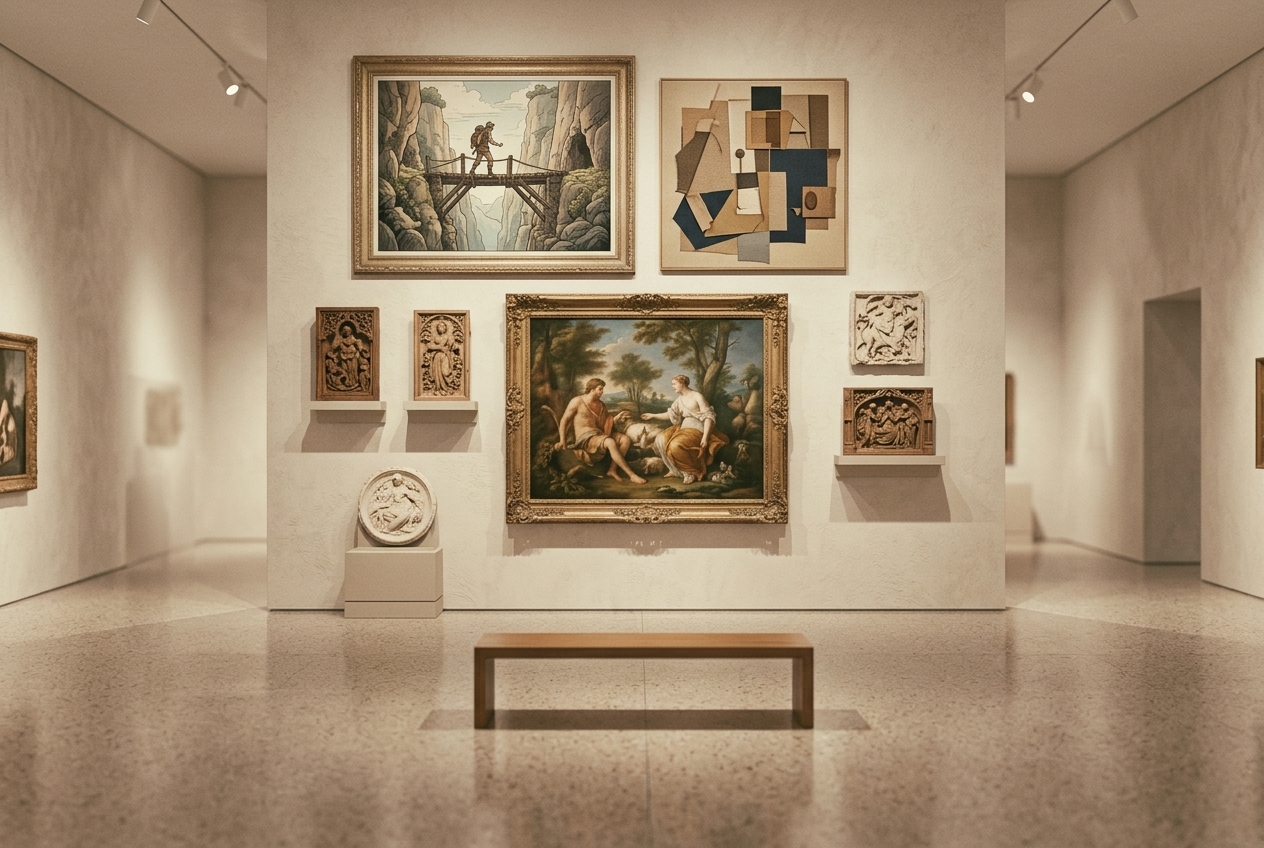
The Lucas Museum of Narrative Art opened to the public in Los Angeles today, some sixteen years and roughly a billion dollars after George Lucas first proposed it — first for San Francisco, then for a lakefront site in Chicago that the group Friends of the Parks sued to keep public, and finally for eleven acres in Exposition Park. Its roughly thirteen hundred objects are arranged not by artist, medium or period but by feeling: galleries named for motherhood, work, family, love. There is very little writing on the walls to explain why a Norman Rockwell painting, a Jack Kirby panel and a reproduction of the Sistine ceiling have ended up under the same heading. That absence is not an oversight. It is the museum’s stated position.
“Art is in the eye of the beholder,” George Lucas told reporters at the opening. “If it’s emotional to you, then it’s art” (ABC News). His co-founder and wife, Mellody Hobson, has described the museum’s organizing idea as myth — “things you believe, but they’re not necessarily true” (CBS News) — and Lucas has said the point of leaving out extended wall text is to let visitors experience the art on their own terms, without being told in advance what to think (Vanguard Culture). A smartphone guide exists for anyone who wants more than that. Nobody is required to use it.
Maximilíano Durón, writing in ARTnews, isn’t persuaded: the museum, in his account, “lacks any kind of narrative,” never supplies “context, interpretation, and a coherent framework,” and would be more honestly named the Lucas Collection of Narrative Art, since a collection is what results when an institution declines the second half of curating. Sam Lubell, in the Los Angeles Times, called the finished building “contradiction-filled” — “synthetic yet organic, monumental yet welcoming, populist yet elitist” — and noted that a lobby built to feel like weather narrows, once you are meant to actually hang something in it, into conventional rooms (Archinect).
The two critics are describing the same gap from different sides of it. Durón wants the reasoning written down; Lubell is disappointed that the building’s own rhetoric — swooping, organic, allegedly boundary-dissolving — gives way to ordinary rectangles the moment someone has to hang a picture in them. Put together, the complaint is that an institution built to refuse categories still needed some, and declined to say which.
That is the part worth taking seriously, because it was never really about labels. A wall label is just where a curator writes her reasoning down so a stranger can check it. Lucas has not dispensed with the reasoning — somebody still decided that motherhood was one of the museum’s organizing feelings and, say, grief apparently was not; still decided which fraction of thirteen hundred objects belongs under that heading; still hung a comic panel at eye level and a canvas above it. Removing the label does not remove that work. It moves the work out of the one part of the museum a visitor is allowed to argue with.
There is an honest version of Lucas’s position, and it is not nothing. Extended wall text has its own history as a gatekeeping habit: comics, illustration and studio concept art spent most of the twentieth century being told, at expository length, exactly why they were not real art, by institutions confident in their own captions. A museum built partly to correct that record has a real reason to distrust the register. Senior curator Ryan Linkof put the museum’s position more modestly than either its founder or its critics: “We’re still figuring things out… And we have all kinds of ideas for what comes next” (CNN, via ABC17News). That is a curator talking, not a manifesto, and it deserves to be read as one.
But modesty about interpretation is not the same as declining to interpret, and the museum’s own opening night undercut the case for silence rather more than any critic did. Pharrell performed. The Black Eyed Peas made a surprise appearance. Drones wrote something in the sky. Queen Latifah told the room that Los Angeles now has “its artistic equal” to the Louvre and the Met (ABC News). The wall text, notably, was the only part of the evening that declined to perform. Nobody at that party left anything up to the beholder; the claims went out loud and specific, hours before a single visitor got near the galleries built, by their own founder’s account, to make no claims at all.
The Louvre did not get built quietly either — a museum never does — but its claims are two centuries old, made by people no longer answerable for them, and can be tested against a public paper trail deep enough to argue with. The Lucas Museum’s claims went up in lights this week, made by the people who wrote the checks, about a building whose actual curatorial argument was left off the wall on purpose. Somebody still chose the gallery called motherhood. The museum only declined to sign the choice.
Sources: ABC News, 21 September 2026; CBS News, 20 September 2026; CNN Style, via ABC17News, 5 September 2026; ARTnews; Archinect, citing the Los Angeles Times, 2 September 2026; Vanguard Culture; Wikipedia, “Lucas Museum of Narrative Art.”