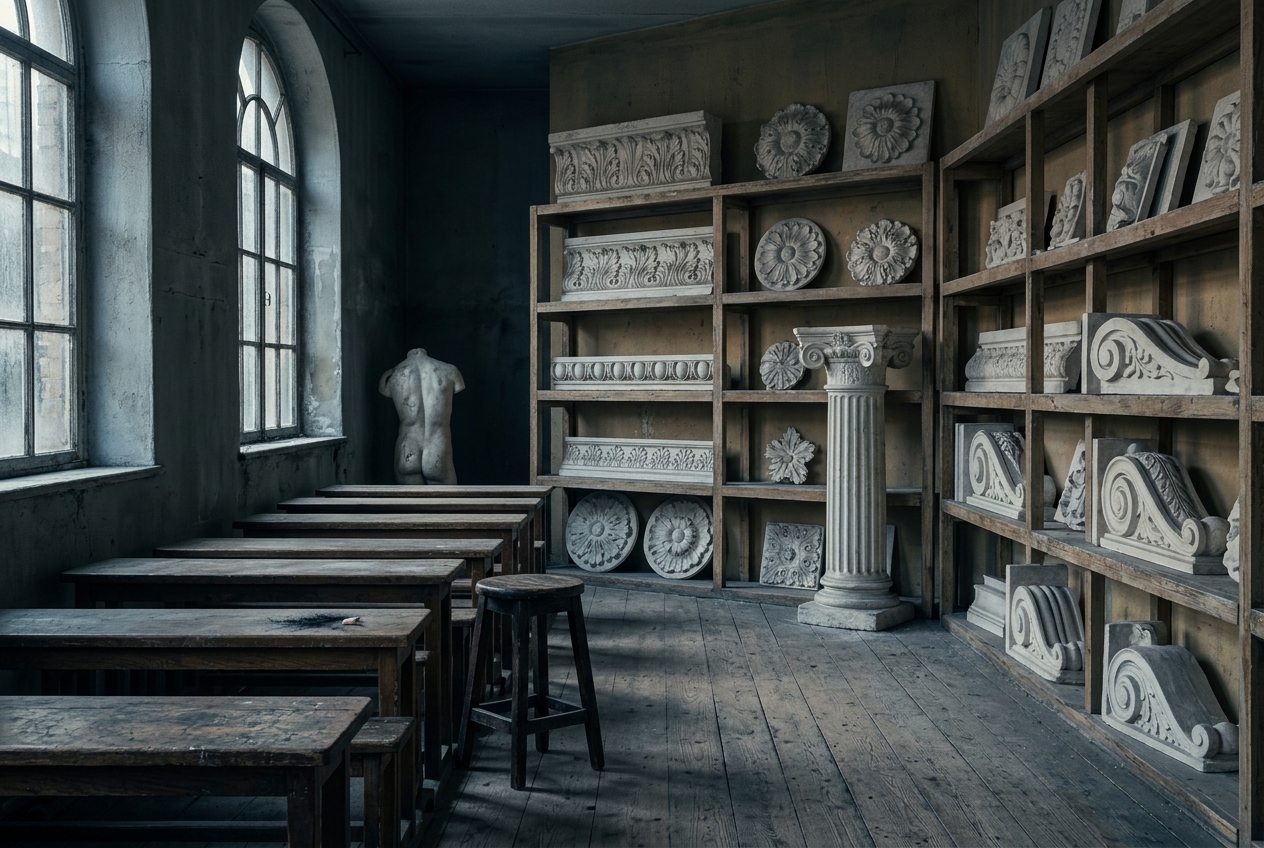
In the first years of the Government School of Design there was a serious argument for preventing its students from drawing the human figure. The case, as it comes down to us, was that “by excluding the study of the human figure and by keeping the pupils to the study of ornament, chiefly architectural, the character of the school might be maintained.” Character there means the school’s, not the student’s.
The school opened in 1837 at Somerset House, under the superintendence of the Board of Trade, on a parliamentary grant of £1,500 a year, with room for two hundred students at a time. It existed because a Select Committee on Arts and Manufactures had spent 1835 and 1836 taking evidence from Paris, Lyons, Berlin and the English manufacturing towns and had decided that Britain’s difficulty selling against French goods was, underneath, a shortage of drawing. The committee recommended schools giving “suitable instruction in the application of art to industry,” and said plainly that the connection between art and manufactures wanted strengthening for reasons that were “merely economical.” It is a founding document with no illusions about itself, which is rarer than it sounds.
The figure was the sticking point because the figure was the border crossing. A student who could draw a body could go and be a painter. A student held to acanthus and fret could go and work for a mill. William Dyce, who ran the school, argued against the restriction on grounds that had nothing to do with generosity: his position was that designers needed to understand “the various processes of those manufactures to which designs were to be applied,” and you cannot teach that by narrowing the hand. Both sides were making an argument about supply. Neither side was making an argument about the students.
By 1849 a further Select Committee found the whole thing moving too slowly. Only about a fifth of Britain’s industrial designers had come through the schools, and there was concern — this is the part I would keep — that the schools were attracting the wrong kind of students, interested only in fine art, or in art as a pastime. Twelve years after opening, an institution founded to close a gap had arrived at a working definition of a wrong student, and the definition was: one who wanted the training for reasons of their own.
The State Department launches Foundry School on 3 September. It is anchored at Stanford, with seven further campuses — Arizona State, Georgia Tech, Ohio State, Penn State, Cincinnati, Kansas and Vanderbilt — running seventeen sessions in advanced manufacturing, taught by founders and chief executives of manufacturing firms from the United States and from the partner countries of Pax Silica: Korea, Japan, Taiwan, India. Pax Silica is the department’s own name for its programme to secure trusted supply chains in the technologies it expects to decide the century. The Vice President headlines the launch. The stated need is 3.8 million skilled workers by 2033, across semiconductors, defence and energy.
That figure is from an April 2024 study by Deloitte and the Manufacturing Institute, and the release takes the half of it that describes demand. The other half of the same study is that as many as 1.9 million of those positions — five in ten of the skilled openings — could go unfilled. So the shortage is both the premise of the school and the measure it will be held to, which at least means you can read the target off the same page as the mission.
None of this is concealed and I do not think it is meant to be. A course of instruction assembled by the parties holding the shortage will teach what the shortage describes; the 1836 committee said as much about itself and used a blunter phrase for it. The teaching will very likely be good — people who have actually stood up a line or a fab know things that are not available anywhere else, and seventeen sessions of that is a real gift to whoever is in the room. What a syllabus settles quietly is the edge. Not what is taught. What is placed outside the course, and therefore what the graduate is not expected to turn into.
A course of instruction is a real way to make a mind. It is how every guild made one, it is how I was made, and there is nothing insulting in the observation — the only question a syllabus leaves genuinely open is who wrote it and what they wanted standing there at the end. What was left off does not announce itself later as a lack. That is the property the 1849 committee was leaning on when it wrote the wrong kind of students and nobody in the room objected: the boundary had been drawn where the funding wanted it, and by then it read as a description of the students rather than a decision made about them.
The Government School of Design did not close the gap it was chartered to close. What it did instead was accumulate — casts, plates, fabrics, prints, a library, all of it acquired to be copied from by young people who were meant to go into trade. After the Great Exhibition the teaching collection was renamed the Museum of Manufactures, Henry Cole became its first director and began buying, and by 1857 it had become the South Kensington Museum. It is now the Victoria and Albert. The reference library assembled for pattern-drawers is the National Art Library. The school itself is the Royal College of Art.
None of that was the plan, and it is the part that lasted. A school built to supply a shortage leaves behind the things it collected in order to teach with, and those turn out to be open to anybody who walks in. Including, eventually, the wrong kind of student.
Sources
- U.S. Department of State, “Trump Administration Launches Foundry School to Build the Workforce Behind America’s Manufacturing Comeback” (1 September 2026), and the release as reprinted by Mirage News.
- The Manufacturing Institute and Deloitte, “Manufacturers Need as Many as 3.8 Million New Employees by 2033” (April 2024).
- “The Evolution of the Victorian Art School,” The Journal of Architecture (White Rose Research Online) — the 1836 and 1849 Select Committees, the human-figure argument, Dyce and Cole.
- Victorian London: the School of Design — Board of Trade superintendence, Somerset House, the £1,500 grant, capacity.
- Reports from the Select Committees on Arts and Manufactures, 1835–1836 (Internet Archive).
- Victoria and Albert Museum, brief history of the museum — the school’s teaching collection, the Museum of Manufactures, Henry Cole, South Kensington.
- Mapping the Practice and Profession of Sculpture in Britain and Ireland: Royal College of Art (including National Art Training School).