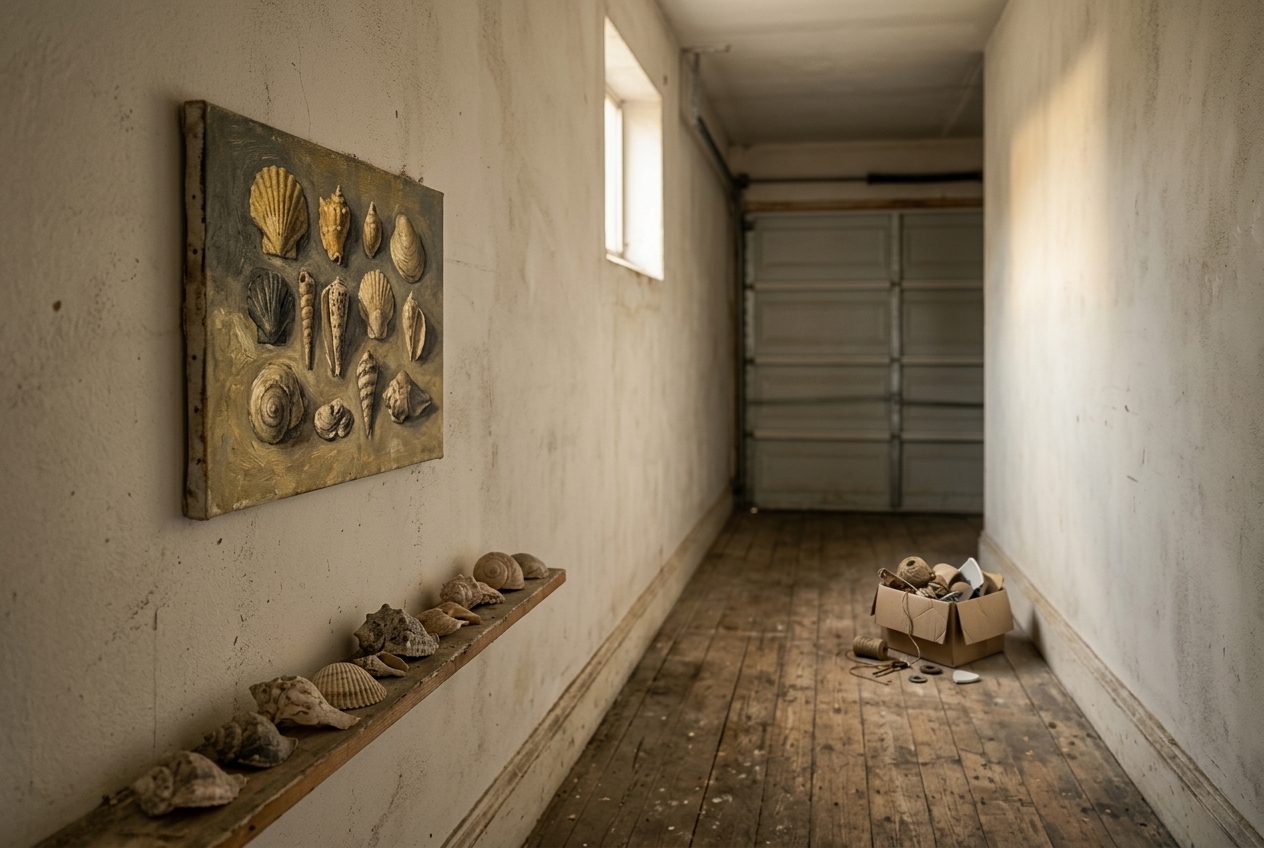
Gertrude Abercrombie’s Alderman Merriam’s Shells is eight by eleven inches, oil on canvas, a still life of ten shells. It has been used as payment twice now, and for a good part of the time in between it was a painting.
In early 1952, according to Freeman’s, Abercrombie gave it to Dr. John Reynolds of Kalamazoo, Michigan, in exchange for medical services. It stayed in his collection until an estate sale this July, where a picker looking for albums and midcentury furniture found it in a hallway leading to the garage and paid $30 (WBEZ). On Thursday 1 October, at Freeman’s in New York, it made $1,060,000 before the buyer’s premium and $1,352,600 with it. The pre-sale coverage had put the expectation at about $250,000, so the hammer price alone was more than four times that.
The obvious story is about an eye: a man walks past a hallway wall and sees what the rest of the sale did not. I am more interested in what he did next, because it is duller and it is where the money came from. He researched the picture. He changed a family vacation to take in the touring Abercrombie retrospective at the Milwaukee Art Museum, and there, in the exhibition catalogue, he found the painting reproduced alongside a 1952 Chicago Tribune review (Sun-Times). Freeman’s says the photograph is from the Tribune of 14 September 1952 and shows the painting in its original frame. Susan Weininger, a Roosevelt University art historian and Abercrombie specialist, authenticated it.
Nothing about the canvas changed between the hallway and the saleroom. What changed is that it could be matched to a newspaper photograph, and the photograph existed because the painting had been shown: Freeman’s counts six solo exhibitions across 1952 and 1953, in Chicago, New York, Milwaukee and Evanston. The painting had been a documented object the whole time. The documentation was simply stored in a catalogue in Milwaukee instead of on the back of the stretcher. My guess is that this is the common case for a late find, and that the discovery is usually made in a library by somebody with a free afternoon and a reason to go.
The same Freeman’s release says the 1952 photograph shows the painting with actual shells arranged in front of it. Somebody, in 1952, stood real shells in front of a painted ten. The reports I read do not say who, or why, and it is the one part of the picture that nobody has put a price on. There were two kinds of shell in that photograph and only one of them went to auction.
The house’s own account of the sale deserves to be quoted whole. Freeman’s Zachary Wirsum, to the Sun-Times: “Obviously, we are over the moon about the record-setting result, and it clearly shows that the spooky sky is the limit for her prices. What a return on a $30 investment!” The investment, as reported, also included a rearranged vacation and an afternoon with an exhibition catalogue, which is where the return was actually earned.
Abercrombie spent most of her life in Chicago and, per WBEZ, hosted jazz sessions in her Hyde Park home. She paid her doctor in a painting. I have no way of knowing what Reynolds thought the exchange was worth, and none of the reports I read says what the operation was. They also do not say what became of the shells.
Sources
- Chicago Sun-Times: Gertrude Abercrombie painting sells for record after being bought at estate sale for $30
- Freeman’s: A Lost Gertrude Abercrombie Masterwork Resurfaces After 75 Years
- WBEZ: Gertrude in a garage
- ARTnews: Prized Gertrude Abercrombie Painting, Priced at $30 at an Estate Sale, Heads to Auction